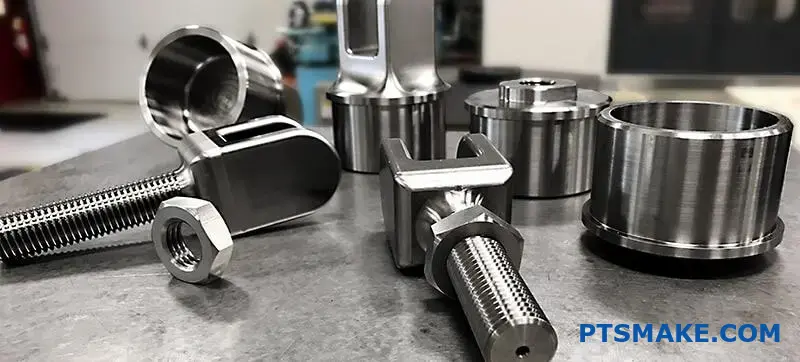

Fingerprint smudges on stainless steel surfaces create constant maintenance headaches for manufacturers and end-users alike. Every touch leaves visible marks that compromise the clean, professional appearance your products need to maintain.
Anti fingerprint coating on stainless steel uses specialized surface chemistry to repel oils and moisture from skin contact. These hydrophobic and oleophobic coatings create an invisible barrier that prevents smudges from adhering to the metal surface.
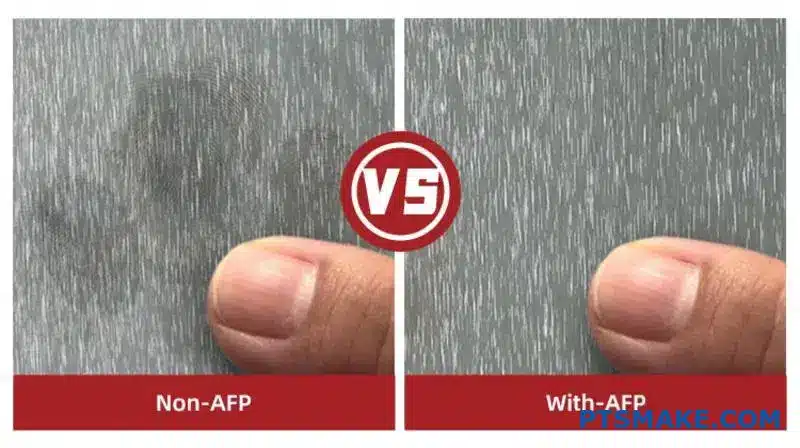
This guide covers everything from the science behind these coatings to real-world performance data across different industries. You’ll learn how to source reliable suppliers, understand lead times, and make informed decisions about when this technology makes sense for your applications.
Top Reasons Engineers Choose Anti Fingerprint Coated Stainless Steel
Engineers constantly seek materials that blend form and function. Standard stainless steel is great, but fingerprints are a major drawback.
This is where an anti fingerprint coating on stainless steel changes the game. It’s more than just aesthetics; it’s about enhanced performance.
Key Advantages for Engineers
This coating provides a clean look and superior protection. It’s a smart choice for functional stainless steel surfaces that must perform under demanding conditions.
| Feature | Standard Stainless Steel | Anti-Fingerprint Coated Steel |
|---|---|---|
| Smudge Visibility | High | Very Low |
| Cleaning Effort | Frequent | Minimal |
| Surface Feel | Cold, Metallic | Smooth, Warm |
This technology ensures products look premium long after they leave the factory.
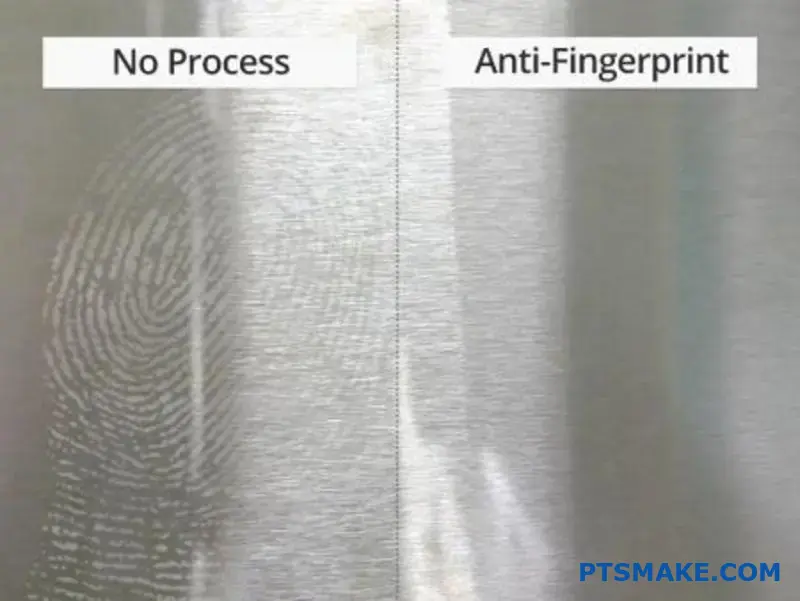
For any high-contact product, surface integrity is crucial. An anti fingerprint coating stainless steel provides a practical and durable solution. It’s not just a coating; it is a functional upgrade that many engineers now specify.
Enhanced Durability and Performance
One of the main reasons for anti-fingerprint stainless finishes is corrosion resistance. The coating adds a protective barrier against moisture and environmental contaminants. This is vital for parts in humid or corrosive settings.
In our tests with clients, we found the coating significantly extends the part’s pristine appearance. It maintains the original look and feel of the steel without compromising its properties.
This coating is often oleophobic1, meaning it repels oils from human skin. This is the core mechanism that reduces smudge visibility.
Coating Technology Breakdown
Different technologies achieve this effect. Some use nanotechnology for a super-thin, invisible layer, while others rely on polymer-based films.
| Coating Type | Key Benefit | Ideal Application |
|---|---|---|
| Nano-Coating | Transparency | Consumer Electronics |
| Polymer Film | Durability | Industrial Appliances |
| PVD Coating | Hardness | High-Wear Components |
Choosing the right type depends entirely on the product’s end-use and the engineer’s specific performance requirements. At PTSMAKE, we help guide this material selection process.
Anti-fingerprint coated stainless steel delivers on multiple fronts. It maintains a clean, professional appearance, enhances corrosion resistance, and improves the user experience. These functional benefits make it a superior choice for engineers designing for both durability and consumer appeal.
The Ultimate Comparison: Coated Vs. Uncoated Stainless Steel In Real Applications
The real test is performance in daily environments. Where does each type of stainless steel truly excel? The answer depends entirely on the application’s demands.
Let’s break down where each finish shines. It’s not just about looks; it’s about long-term function and maintenance.
High-Moisture vs. High-Traffic
In high-moisture areas like bathrooms, corrosion is the enemy. For high-traffic zones like kitchens, fingerprints and smudges become the primary concern.
A quick comparison shows their strengths.
| Environment | Uncoated Stainless Steel | Coated Stainless Steel |
|---|---|---|
| Bathroom (Moisture) | Good corrosion resistance | Excellent corrosion & stain resistance |
| Kitchen (Traffic) | Shows smudges easily | Hides fingerprints well |
| Industrial (Harsh) | Very durable, shows wear | Durable, protects base metal |
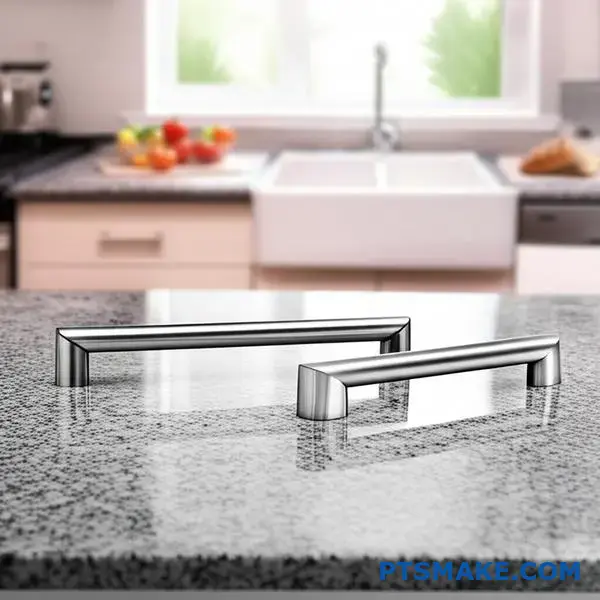
Let’s dive deeper into specific use cases. The choice between coated vs non-coated stainless steel becomes clearer when you examine the stressors of each environment. It’s a balance of aesthetics, durability, and cost.
Kitchen Appliances: The Aesthetic Challenge
In kitchens, appearance is critical. Uncoated stainless steel looks premium but is a magnet for fingerprints and grease. An anti fingerprint coating stainless steel is a game-changer here. It uses an oleophobic coating2 to repel oils from hands, drastically reducing cleaning time.
Bathrooms: Fighting Moisture and Stains
Bathrooms introduce constant moisture and potential for soap scum or water spots. While standard 304 stainless is resistant, a specialized coating adds another layer of protection. This barrier prevents hard water stains and makes cleaning simpler.
Industrial Control Cabinets: Durability First
For industrial settings, durability trumps aesthetics. Uncoated stainless steel is tough and withstands scratches. However, in our anti-fingerprint stainless performance tests, we found coated versions offer enhanced protection against chemical splashes and grime, simplifying maintenance.
| Application | Key Challenge | Recommended Finish | Why? |
|---|---|---|---|
| Kitchen Refrigerator | Fingerprints, Grease | Coated (Anti-Fingerprint) | Maintains a clean look |
| Bathroom Fixtures | Water Spots, Soap | Coated | Eases cleaning, adds protection |
| Industrial Cabinet | Scratches, Grime | Uncoated or Coated | Uncoated for pure toughness, coated for easier upkeep |
The right finish depends on the environment. For high-touch, aesthetic-focused areas, an anti fingerprint coating is superior. In purely functional, high-wear settings, uncoated steel remains a strong, cost-effective contender.
B2B Sourcing Guide: Finding A Reliable Supplier For Coated Stainless Steel
Once you have a shortlist, it’s time to dig deeper. The Request for Quotation (RFQ) stage is more than just about price. It’s your first real test of a supplier’s expertise.
Your goal is to get specific, actionable answers. A vague RFQ leads to vague quotes and potential problems. Effective anti fingerprint finish B2B sourcing hinges on asking the right questions from the start.
Crafting a Detailed RFQ
A strong RFQ sets clear expectations. It helps you compare potential partners on an equal footing. Ask questions that reveal their technical capabilities and quality control processes.
| Category | Key Questions to Ask |
|---|---|
| Coating Specs | What type of anti-fingerprint coating do you use? What is the standard thickness? |
| Material | Which stainless steel grades (e.g., 304, 430) are available for coating? |
| QC Process | How do you ensure coating uniformity and durability? |
| Lead Time | What is the production lead time for sample orders vs. bulk orders? |

Beyond the Spec Sheet: Sample Inspection
A spec sheet provides data, but a physical sample tells the real story. When you receive samples of anti fingerprint coating stainless steel, don’t just glance at them. Scrutinize them carefully under different lighting conditions.
Look for consistency in color and finish across the entire surface. Are there any blemishes, bubbles, or uneven patches? These are red flags. A reliable fingerprint resistant steel supplier will provide a flawless sample. Perform simple tests, like a coin scratch test, to gauge durability.
Crucially, ask about their Adhesion Testing3 methods. This process is vital for ensuring the coating won’t peel or flake over time. The results from these tests often reveal the true quality of the product.
Validating Quality: Certification Requirements
Certifications are your proof of a supplier’s commitment to quality and compliance. They aren’t just pieces of paper; they represent established, audited processes that reduce your risk.
At a minimum, look for ISO 9001. This certification demonstrates a solid quality management system. For products intended for specific markets, especially in Europe, you must also verify RoHS and REACH compliance.
At PTSMAKE, we make this a mandatory step in our own sourcing. Requiring these documents upfront ensures that our partners meet the global standards our clients expect. It simplifies the entire supply chain.
A detailed RFQ, hands-on sample inspection, and verification of certifications are essential. These steps ensure your supplier can meet your quality standards and prevent costly production issues. They form the foundation of successful B2B sourcing.
Are Fingerprint Resistant Surfaces Scratch-Proof? The Truth Explained
Many clients assume an anti-fingerprint surface is also scratch-proof. This is a common and understandable misconception. Let’s clarify the expectations.
These specialized coatings are engineered to repel oils from our skin. Their primary function isn’t to defend against sharp objects like keys or metal utensils.
The real conversation is about mechanical durability and stainless coating wear resistance. How does an anti fingerprint coating stainless steel surface truly hold up to daily wear and tear?
| Feature | Common Expectation | Coating Reality |
|---|---|---|
| Scratch Resistance | Invincible to all scratches | Resists minor, light abrasions |
| Durability | Lasts indefinitely | Has a finite lifespan |
| Main Function | Blocks all marks and damage | Repels oils, reduces smudges |
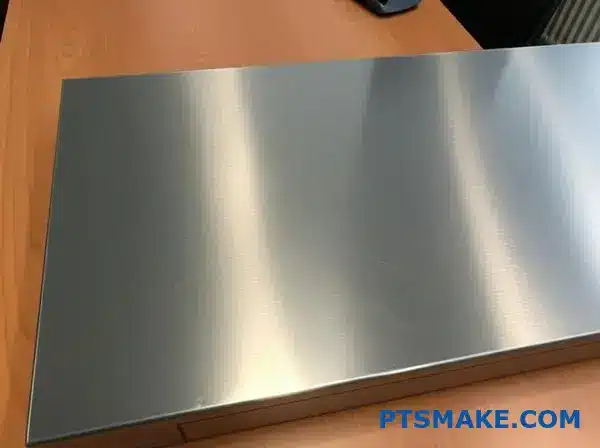
Unpacking Mechanical Durability and Abrasion
Let’s dive deeper into the mechanical strength of these coatings. Their stainless coating wear resistance can vary dramatically depending on the chemical composition and application process.
Some are simple oleophobic layers that offer minimal physical protection. Others involve advanced nano-ceramic particles. These provide significantly better durability against daily friction and cleaning.
How Durability Is Measured
In the manufacturing world, we don’t guess. We use standardized tests to quantify strength. The Pencil Hardness Test, for example, is a straightforward way to gauge a surface’s resistance to scratching.
A coating with a high rating, like 9H, is extremely tough. It can fend off scratches from most common items. A lower rating indicates a softer, more vulnerable surface. This quality is crucial for scratch resistance anti fingerprint stainless steel parts in high-contact areas.
This durability is directly influenced by the coating’s tribology4. It’s the science of how surfaces interact when they move against each other. At PTSMAKE, we guide our clients to the right balance. We ensure the anti fingerprint coating stainless steel meets both aesthetic desires and the functional demands of its environment.
| Coating Type | Typical Hardness (Pencil) | Best Application |
|---|---|---|
| Oleophobic Spray-On | < 2H | Light-use electronics, interior panels |
| Nano-Ceramic | 7H – 9H | Kitchen appliances, high-traffic surfaces |
| PVD/DLC Coatings | > 9H | Industrial equipment, luxury goods |
Anti-fingerprint coatings primarily resist oils, not scratches. Their mechanical durability is not absolute and varies by type. Understanding a coating’s hardness and wear resistance is key to setting realistic performance expectations for stainless steel surfaces.
Fast Facts: Lead Times And MOQ For Coated Stainless Steel Parts
Understanding timelines and volume is key. Many clients ask about the lead time for coated stainless parts. It varies, but I can provide some general guidelines.
For small or prototype orders, speed is essential. Large orders require more planning for efficiency.
Production Timeline & Volume Overview
| Order Size | Typical MOQ | Typical Lead Time |
|---|---|---|
| Small / Prototype | 1-100 pieces | 1-3 Weeks |
| Large / Production | 1,000+ pieces | 4-8 Weeks |
The MOQ anti fingerprint coating process depends heavily on the part’s complexity and the specific coating requirements. These are just starting points for discussion.
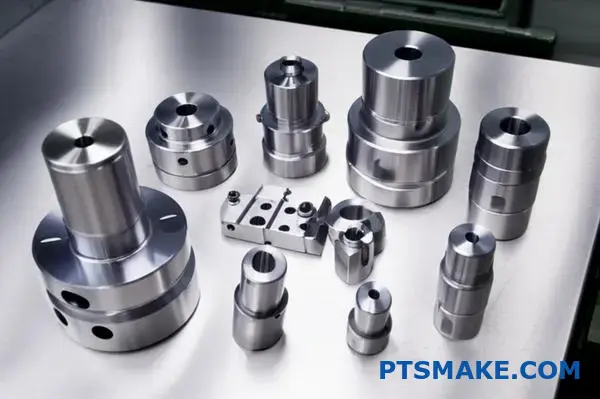
Breaking Down Production Timelines
Several factors influence the schedule. The initial setup for applying an anti fingerprint coating on stainless steel is a critical step. It often dictates the pace for the entire project.
For smaller orders, we can move quickly. We often use more flexible setups. This allows for faster turnaround but may have a slightly higher per-unit cost. It’s a trade-off between speed and volume pricing.
Large Orders: Planning for Scale
For larger production runs, planning is everything. We establish a dedicated production line. This ensures consistency and optimizes cost. Rigorous quality checks are integrated at every stage.
This initial setup takes time. But once running, the output is highly efficient. This stage requires thorough process validation5 to guarantee every part meets specifications.
| Factor | Impact on Small Orders | Impact on Large Orders |
|---|---|---|
| Setup Time | Minimal, fast turnaround | More extensive, longer initial phase |
| Material Prep | Handled per batch | Streamlined and automated |
| Curing Process | Standard cycles | Optimized for continuous flow |
| Quality Control | 100% inspection | Statistical Process Control (SPC) |
At PTSMAKE, we work with you to align the production plan with your project goals, whether it’s for a quick prototype or full-scale manufacturing.
Understanding lead times and MOQs for coated stainless steel parts is crucial for project planning. Small orders offer speed, while large orders provide efficiency and cost benefits after an initial setup period.
The Power Of Surface Chemistry: Why Fingerprints Don’t Stick
Have you ever wondered why some surfaces stay clean while others are fingerprint magnets? The secret lies in chemistry. Anti-fingerprint coatings create a barrier that repels oils and water.
The Science of Repulsion
These coatings are designed to be both hydrophobic (water-repelling) and oleophobic (oil-repelling). This dual action is crucial.
It ensures that neither the moisture nor the oils from your skin can properly adhere to the surface. It’s all about minimizing surface contact.
| Property | Repels | Main Component in Fingerprints |
|---|---|---|
| Hydrophobic | Water | Sweat, Moisture |
| Oleophobic | Oil | Skin Oils, Grease |
Additionally, anti-static properties help. They prevent dust from clinging, which can trap fingerprint residues. This is how anti fingerprint surfaces work effectively.
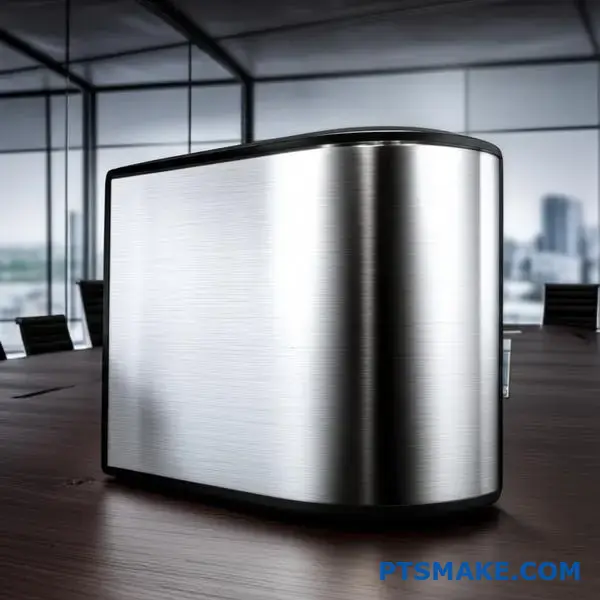
At PTSMAKE, we often apply these coatings to parts for consumer electronics and appliances. The magic happens at the stainless coating molecular level. Think of it as creating a perfectly smooth, low-energy shield.
How Coatings Create a Barrier
Most anti-fingerprint coatings use fluoropolymers. These molecules have extremely low surface energy. This means liquids, like the oils from your fingers, bead up and roll off instead of spreading out and sticking.
The coating creates a microscopic texture. This texture reduces the contact area for contaminants. This is a core principle for an anti fingerprint coating stainless steel. A key property of these coatings is being oleophobic6, which specifically targets skin oils.
Key Components and Their Functions
This is not just a single layer. It’s a carefully engineered system. Anti-static agents are often included. They dissipate static charge, stopping dust and other particles from being attracted to the surface, which keeps it cleaner for longer.
| Component | Primary Function | Effect on Fingerprints |
|---|---|---|
| Fluoropolymers | Lower surface energy | Repels oils and water |
| Silanes | Bond coating to substrate | Ensures durability |
| Anti-Static Agents | Dissipate electrical charge | Prevents dust attraction |
Understanding this chemistry allows us to select the right coating for high-touch components, ensuring they maintain their appearance and function over time.
Anti-fingerprint coatings use advanced surface chemistry. By creating hydrophobic, oleophobic, and anti-static barriers at a molecular level, they effectively prevent the oils, water, and dust that make up fingerprints from sticking to the surface.
Medical-Grade Clean: Is Anti Fingerprint Stainless Steel Safe For Clinics & Devices?
When a part is for medical use, safety is non-negotiable. The question is whether an anti fingerprint coating stainless steel finish meets these high standards.
The answer depends entirely on the coating’s specific formulation.
Biocompatibility Concerns
The primary concern is how the coating interacts with human tissue. It must be non-toxic and cause no adverse reactions.
Sterility and Durability
Medical devices undergo harsh sterilization. The coating must withstand autoclaving or chemical agents without degrading.
Essential Certifications
Certifications are not optional. They provide proof of safety for a healthcare safe fingerprint coatings application.
| Feature | Standard Stainless Steel | AFP Coated Stainless Steel |
|---|---|---|
| Biocompatibility | Excellent (e.g., 316L) | Varies by coating formula |
| Sterilization | Highly resistant | Must be tested for compatibility |
| Certifications | Established (ISO, FDA) | Requires specific certification |

The core issue isn’t the stainless steel itself, but the added coating layer. At PTSMAKE, when a client specifies a medical device stainless finish, our first step is a deep dive into the material supplier’s data sheets. We have to verify the specific composition of the anti fingerprint coating.
Understanding Biocompatibility
Not all coatings are created equal. Some use polymers or nano-particles that could potentially leach or break down over time. This is unacceptable in a clinical setting. We always look for coatings that have passed rigorous testing for biocompatibility7.
Surviving Sterilization Cycles
We also consider the device’s lifecycle. A reusable surgical tool might be autoclaved hundreds of times. Will the anti fingerprint coating stainless steel endure this? Based on our tests, some coatings can discolor or lose their hydrophobic properties after repeated high-heat sterilization, compromising their function and cleanability.
Navigating Regulatory Approval
Finally, there are certifications. Materials used in medical devices often require compliance with standards like ISO 10993. The coating, as a surface that may have patient contact, must meet these standards. Without an FDA-compliant or ISO-certified coating, the material is a non-starter for most medical applications we handle.
The safety of anti fingerprint stainless steel in medical settings hinges on the coating’s specific formula. Verifying its biocompatibility, durability under sterilization, and possession of relevant certifications like ISO 10993 is critical before any clinical application.
Coated Stainless Steel For Consumer Hardware: Boost Perceived Quality Instantly
The final finish on a product is the first thing a customer touches. It’s their initial physical interaction. This moment defines their perception of quality. A premium look on stainless steel instantly communicates value.
It’s not just about looks. A high-end finish feels different. It feels solid, smooth, and intentional.
The Power of Touch
A user’s satisfaction is closely tied to tactile experience. An anti-smudge finish keeps electronics and appliances looking clean. This reduces frustration and reinforces the purchase decision.
From the Shelf to Daily Use
How a product withstands daily use matters. Coatings protect against minor scratches and wear, maintaining that "new" feeling for longer.
| Feature | Standard Stainless Steel | Coated Stainless Steel |
|---|---|---|
| First Impression | Good | Excellent, Premium |
| Feel | Cold, Standard | Smooth, High-End |
| Durability | Prone to smudges | Resists fingerprints |

A product’s finish is a key part of the user experience. It can be the difference between a product that feels generic and one that feels premium. End-user satisfaction often comes down to these small, well-executed details.
Enhancing Daily Interaction
Think about high-traffic consumer goods like kitchen appliances. An anti-smudge finish for consumer goods is not a luxury; it’s a practical benefit. It means less cleaning and a consistently clean look. This simple feature improves the user’s daily life.
The resistance to fingerprints and oils is crucial. This is often achieved through a special oleophobic coating8 that actively repels skin oils. At PTSMAKE, we often advise clients on these coatings for parts that will be frequently handled.
Long-Term Value Perception
A finish that resists wear and stays clean helps a product age gracefully. This extends the perception of quality far beyond the initial purchase. A device that looks good after a year of use is a testament to its manufacturing quality.
Below is a comparison of user experience over time.
| Timeframe | Uncoated Surface | Anti-Fingerprint Coated Surface |
|---|---|---|
| Day 1 | Looks clean | Looks clean and feels smooth |
| Week 1 | Shows smudges and prints | Remains pristine, easy to wipe |
| Year 1 | Appears worn, needs constant cleaning | Retains its premium look |
This sustained quality builds brand loyalty. Users are more likely to repurchase from a brand they trust to deliver durable, well-made products.
High-end finishes significantly boost end-user satisfaction. They create a premium first impression, improve daily interaction by resisting smudges, and maintain the product’s quality appearance over time. This enhances perceived value and builds lasting customer loyalty.
Long-Term Exposure: How Anti Fingerprint Coatings Perform Over 5+ Years
How does an anti fingerprint coating on stainless steel truly hold up? Lab tests are useful, but real-world exposure tells the full story.
We look at performance over 5+ years. This data comes from outdoor installations and high-traffic indoor environments.
The key factors we analyze are UV exposure, humidity, and physical wear. These elements determine true long-term stainless coating durability.
Here’s a glance at our typical test parameters for an anti-smudge weatherproof test.
| Test Parameter | Duration | Success Metric |
|---|---|---|
| UV Exposure (QUV) | 2000 hours | < 5% Color Change |
| Humidity Chamber | 1000 hours | No Peeling/Blistering |
| Abrasion (Taber) | 500 cycles | Minimal Haze/Loss |
This data provides a clear picture of what to expect from a high-quality coating.
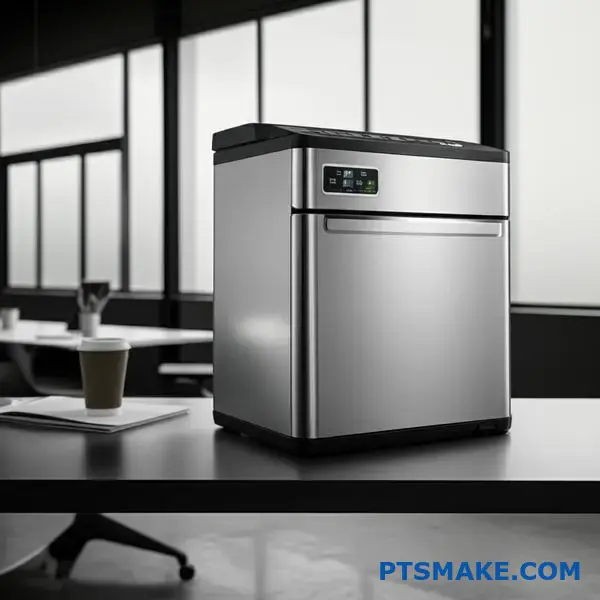
Real-world conditions are the ultimate test for any coating. After working with clients on architectural projects, we’ve gathered significant data on long-term performance. It’s not just about looking good on day one. It’s about maintaining that finish for years.
UV Exposure Case Study
A major challenge for exterior parts is UV radiation. We saw an early-generation coating on an outdoor kiosk begin to yellow after three years. The chemical bonds in the coating were breaking down. This process is known as photodegradation9. Modern formulations now include advanced UV inhibitors. These protect the coating’s integrity and color.
Humidity and Environmental Stress
In coastal areas, humidity and salt are relentless. Our anti-smudge weatherproof test on stainless steel panels for a seaside hotel showed interesting results. After five years, coatings with poor adhesion started to peel at the edges. The best performers used a formulation that chemically bonded to the steel substrate. This prevented moisture from getting underneath.
Wear and Tear Analysis
High-traffic areas like elevator panels or kitchen appliances face constant contact. In our tests, we found that coating thickness is not the only factor. The coating’s hardness and flexibility matter more.
| Coating Type | UV Resistance | Humidity Adhesion | Abrasion Score (1-10) |
|---|---|---|---|
| Acrylic | Moderate | Good | 6 |
| Polyurethane | High | Excellent | 8 |
| Sol-Gel | Excellent | Excellent | 9 |
This data, gathered with our clients, highlights why we often recommend Sol-Gel for demanding applications at PTSMAKE.
Long-term performance data is crucial. UV radiation, humidity, and daily abrasion are the main challenges for anti fingerprint coatings on stainless steel. Choosing the right formulation based on the specific environment ensures durability and a lasting finish, preventing costly replacements.
Unbox Appeal: Visual Impact Of Smudge-Free Steel On First Impressions
The first physical interaction with a product is critical. This moment sets the tone for the entire user experience. A pristine, clean surface communicates quality.
The Power of a Perfect First Touch
When a customer unboxes new hardware, what do they see? A smudge-free finish on stainless steel delivers an immediate "wow-factor." It feels premium and professional.
Conversely, a surface covered in fingerprints suggests mishandling. It can cheapen an otherwise well-engineered part.
Comparing Initial Impressions
This initial reaction can influence the perception of the entire product. A clean presentation matters.
| Feature | Smudge-Free Finish | Standard Finish |
|---|---|---|
| First Look | Clean, premium, flawless | Marked, used, lower quality |
| First Touch | Smooth, high-tech feel | Oily, requires cleaning |
| Impression | High value, meticulous | Rushed, careless |
This stainless steel unbox design is a small detail. But it makes a huge difference in perceived value.

The unboxing experience extends beyond the initial reveal. It carries through to the installation process. Technicians and engineers are the first true users.
Enhancing the Installation Experience
When a technician handles a part, an anti fingerprint coating stainless steel surface resists oils and smudges. The component looks as good installed as it did in the box. This maintains the premium feel throughout the setup.
This detail reflects positively on your brand’s commitment to quality. It shows you’ve considered the entire product journey, from our factory at PTSMAKE to its final application.
The sensory feedback from a clean part builds confidence. It reinforces the idea that the component is high-precision and manufactured to the highest standards. The user’s haptic perception10 of the object is immediately positive.
From Box to Build: A Seamless Journey
We’ve seen this with clients in the medical device and high-end consumer electronics sectors. A clean part simplifies handling and inspection. It also boosts the installer’s confidence in the product’s quality.
| Stage | Impact of Smudge-Free Finish |
|---|---|
| Unboxing | Creates a strong, positive first impression. |
| Handling | Part remains clean and pristine during assembly. |
| Installation | Looks professional and high-quality in the final product. |
| Final Review | Customer sees a flawless end result. |
A smudge-free finish ensures the product’s visual integrity is maintained from the moment it’s unboxed to when it’s fully installed. This small feature provides a significant return in user experience.
A smudge-free stainless steel finish is crucial for the unboxing and installation experience. It provides an immediate visual cue of quality, creating a lasting positive impression that enhances brand perception and boosts user confidence from the very first interaction.
Regulatory Insights: Which Industries Demand Fingerprint-Free Stainless?
It’s not just about looks. Specific industries require fingerprint-free stainless steel to meet strict regulations. These rules are all about safety and hygiene.
They ensure surfaces are easy to clean and maintain. This is critical in sensitive environments.
Key Industries and Their Standards
Certain sectors have clear rules. These rules directly or indirectly promote the use of clean, non-porous surfaces. This makes fingerprint-resistant steel a preferred choice.
Here’s a quick look at some key industry standards:
| Industry | Relevant Standards/Regulations | Core Requirement |
|---|---|---|
| Food & Beverage | NSF/ANSI Standards | Non-absorbent, corrosion-resistant surfaces |
| Medical Devices | ISO 13485, FDA GMP | Sterility, ease of sanitization |
| Cleanrooms | ISO 14644-1 | Control of airborne particulate |
Following these fingerprint resistant steel industry standards is mandatory for compliance.
The demand for these materials isn’t arbitrary. It’s driven by the need to prevent contamination and ensure safety. Clean surface compliance is a non-negotiable aspect of production in many fields.
Why Cleanliness is Mandated
In the food industry, standards like NSF/ANSI exist to prevent bacterial growth on equipment. A surface that resists smudges and oils is inherently easier to sanitize, reducing the risk of foodborne illness. Anti fingerprint coating stainless steel provides this exact benefit.
For medical applications, the stakes are even higher. FDA regulations and ISO 13485 guide the manufacturing of devices. Surfaces must be impeccably clean to prevent infections. The non-porous nature of coated stainless steel helps ensure no microscopic contaminants remain after cleaning.
The Role in Controlled Environments
Cleanrooms are a different but related challenge. Standards like ISO 14644-1 focus on limiting contamination. In these settings, minimizing particulate contamination11 is the primary objective. Every surface must be smooth and easy to wipe down, leaving no residue behind.
At PTSMAKE, we often work with clients on components for these regulated industries. We help them select materials that meet both functional needs and strict compliance requirements.
Regulations in food, medical, and cleanroom sectors demand easily sanitized surfaces. This drives the adoption of fingerprint-resistant stainless steel, ensuring both hygiene and operational compliance.
Cross-Industry Use Cases: From Elevators To Automotive Accessories
The application of anti fingerprint coating stainless steel is surprisingly broad. It goes far beyond just kitchen appliances. This technology solves real-world problems in high-traffic and luxury environments.
We see its value in many projects. It maintains a clean, premium look where impressions matter most.
Public and Commercial Spaces
Think about high-touch surfaces. An elevator antimicrobial surface is now a key requirement for health and safety. The coating helps reduce the visible prints and smudges, making spaces feel cleaner.
Automotive Interiors
In the luxury market, details define the experience. Automotive fingerprint resistant stainless steel is crucial for trim, dashboards, and control panels. It maintains that pristine, showroom look for the owner.
| Industry | Primary Benefit | Key Application |
|---|---|---|
| Public Transport | Hygiene & Reduced Maintenance | Elevator Panels, Handrails |
| Automotive | Aesthetics & Perceived Value | Interior Trim, Touch Controls |
| Electronics | Durability & Cleanliness | Laptop Casings, Premium Devices |

The real driver for these coatings is not just looks. It’s about long-term performance and user perception. A surface that resists smudges simply feels higher quality and is easier to maintain. This directly impacts brand value and customer satisfaction.
The Science of a Clean Surface
The technology works by creating a very thin, durable film. This layer is often oleophobic12, meaning it repels the oils from our skin. This is why fingerprints, which are mostly oil and sweat, don’t adhere easily.
At PTSMAKE, we guide clients on the right finish. It’s a critical choice that affects both manufacturing and the final product’s appeal. For instance, the coating process must be compatible with the part’s geometry and material.
We’ve seen that selecting the right anti fingerprint coating stainless steel can reduce post-sale cleaning complaints for our clients. It also enhances the product’s lifespan by protecting the surface from corrosion caused by skin acids.
Comparing Functional Impacts
The choice of coating has tangible benefits that differ by industry. These benefits influence the total cost of ownership and the user experience over time.
| Feature | Impact in Automotive | Impact in Public Spaces |
|---|---|---|
| Smudge Resistance | Maintains luxury feel | Reduces cleaning frequency |
| Durability | Resists wear from daily use | Withstands harsh cleaning agents |
| Antimicrobial | N/A | Inhibits bacterial growth |
| Corrosion Shield | Protects from spills, moisture | Extends material life |
This shows that a single technology can solve very different problems. It’s a versatile solution for modern product design.
Anti-fingerprint coatings offer significant value beyond simple aesthetics. They enhance hygiene in public areas like elevators and uphold a premium feel in automotive interiors, directly impacting maintenance costs and user perception of quality.
Get Your Custom Anti Fingerprint Coating Stainless Steel Solution from PTSMAKE!
Ready to experience the superior performance of anti fingerprint coating stainless steel for your next project? Contact PTSMAKE now for a fast, detailed quote—trusted by leading engineers and procurement teams for precision, reliability, and seamless communication from prototype to high-volume production.

Discover how oil-repellent surfaces are engineered and why they are critical for modern materials. ↩
Explore the science behind this oil-repelling surface technology. ↩
Learn how adhesion tests directly impact the durability and performance of the anti fingerprint finish. ↩
Learn how friction, wear, and lubrication principles determine a coating’s real-world lifespan. ↩
Learn how this step ensures consistent quality for your large-scale production runs. ↩
Discover the science behind oil-repellent surfaces and how they are engineered. ↩
Learn more about the standard biological evaluation tests for medical device materials. ↩
Explore the technical details of how these specialized coatings create anti-smudge surfaces. ↩
Understand the science behind how UV light degrades materials and why it matters for your product’s lifespan. ↩
Learn how the sense of touch directly influences a user’s perception of product quality and overall value. ↩
Learn more about how surface materials impact contamination control in sensitive environments. ↩
Understand the science behind how these coatings repel oils and smudges. ↩