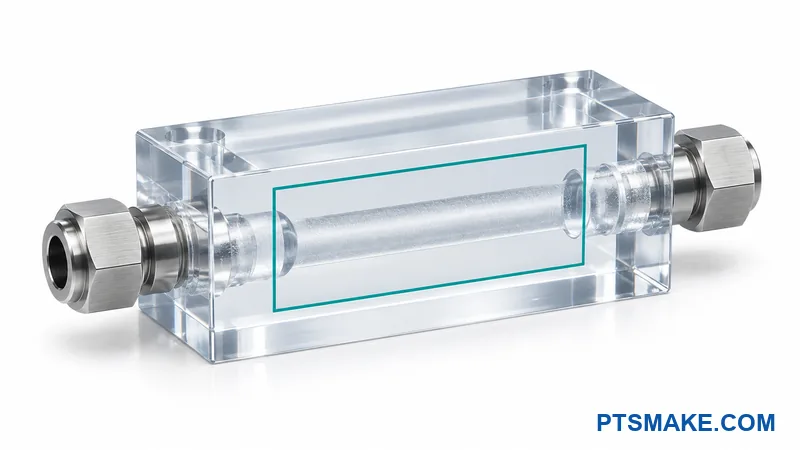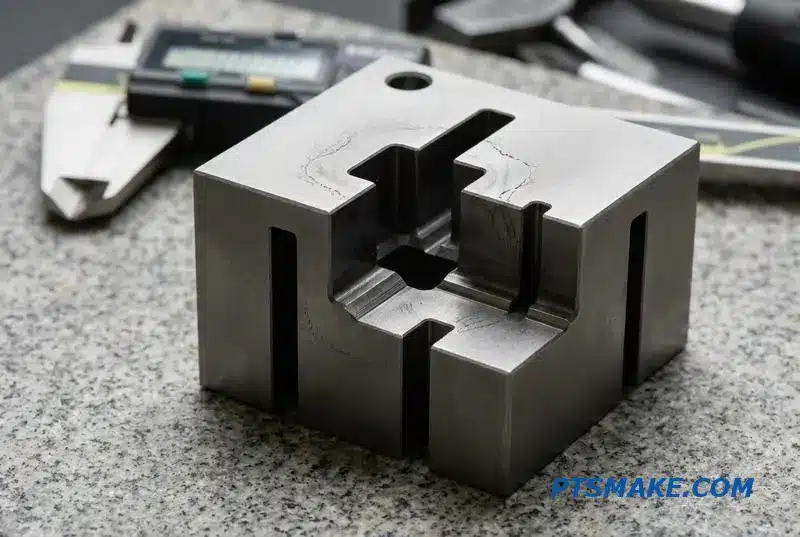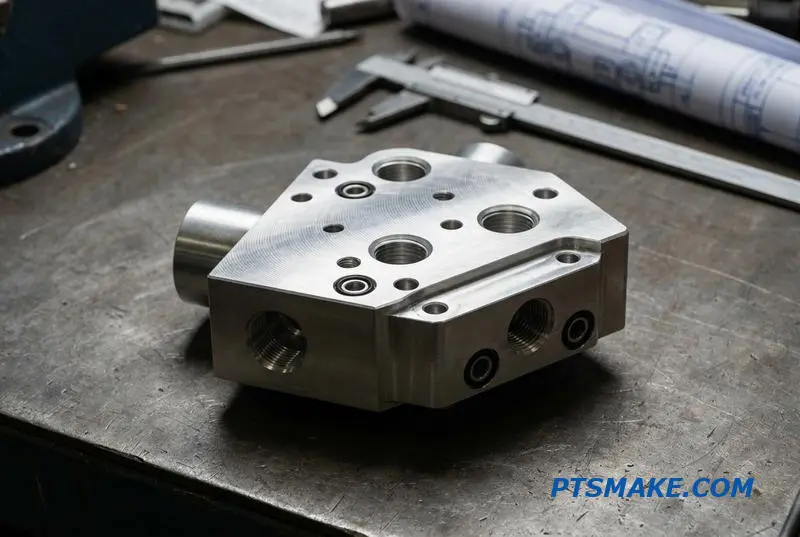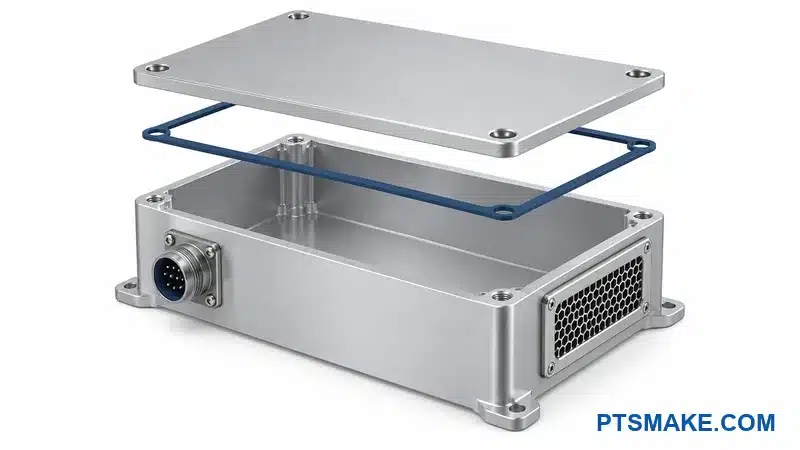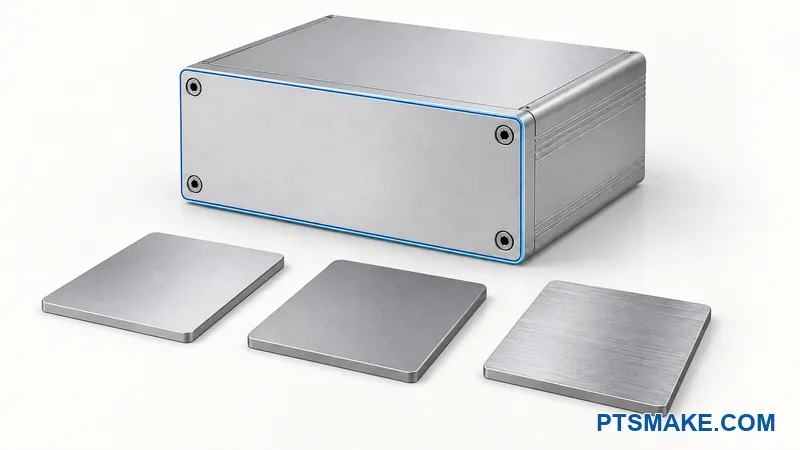

Sourcing precision CNC machined parts shouldn’t feel like a gamble. Yet many buyers still receive parts with wrong tolerances, poor finishes, and missed deadlines, costing thousands in rework and lost production time.
Precision CNC machining is a subtractive manufacturing process that produces parts with tolerances as tight as ±0.005mm using computer-controlled cutting tools. It works for metals and plastics across aerospace, medical, robotics, and automotive industries.
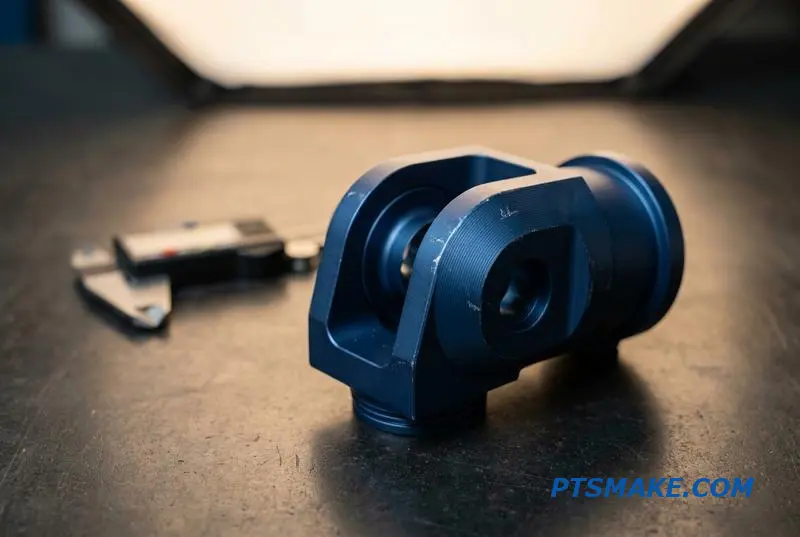
In this guide, I’ll walk you through what really matters when buying precision CNC parts in 2026, from tolerances and materials to costs, finishes, and scaling production. Each section gives you practical answers I’ve shared with buyers like you.
What Tolerances Can You Actually Expect From Precision CNC Machining?
When designing a part, specifying the right tolerance is crucial. It’s a balance between function and cost. Unnecessarily tight tolerances can drive up expenses, while loose ones can lead to failure. Understanding what’s achievable in precision CNC machining helps you make informed decisions.
Understanding Tolerance Tiers
There are generally three tiers. Standard tolerance is typically around ±0.05mm, suitable for most applications. Tight tolerance machining pushes this to ±0.01mm for more demanding fits. Ultra-precision, which we often handle at PTSMAKE, can reach ±0.005mm for critical components.
Tolerance by Machine Type
The machine itself plays a significant role in achieving these figures. More advanced multi-axis machines can hold tighter tolerances on complex geometries in a single setup, reducing error stack-up.
| Machine Type | Typical Achievable Tolerance Range | Best For |
|---|---|---|
| 3-Axis CNC | ±0.025mm to ±0.1mm | Simpler geometries, flat surfaces, basic parts |
| 4-Axis CNC | ±0.015mm to ±0.05mm | Parts requiring machining on multiple faces |
| 5-Axis CNC | ±0.005mm to ±0.02mm | Highly complex parts, organic shapes, single-setup |
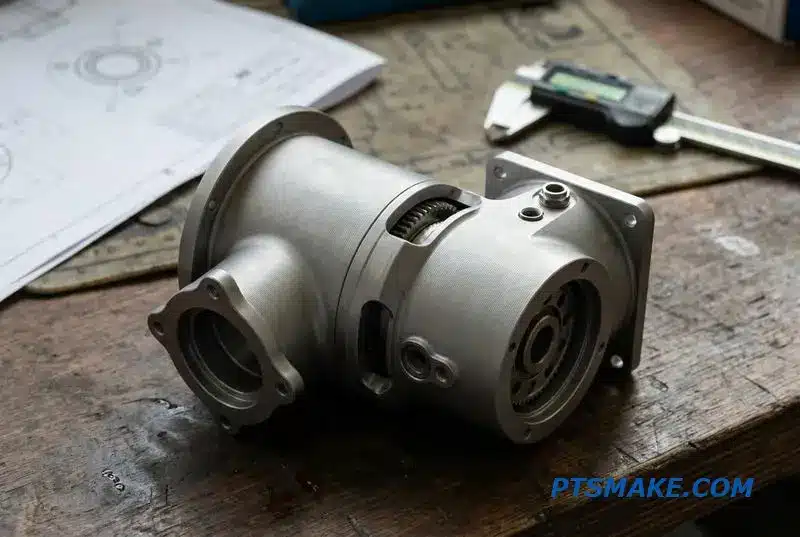
Beyond the Numbers: What Influences Tolerances?
Achieving high precision CNC tolerances isn’t just about the machine. Material choice is a major factor. Softer materials like aluminum are easier to machine accurately than hardened steels, which can cause more tool wear and deflection, affecting the final dimensions.
The Cost of Precision
Pushing for the tightest possible tolerance isn’t always the best strategy. Each incremental step in precision exponentially increases cost. This is due to slower machine speeds, more expensive tooling, and rigorous inspection processes required. It’s a classic case of diminishing returns.
Communicating Your Needs Effectively
Clear communication is key. Use Geometric Dimensioning and Tolerancing (GD&T) on your drawings to define critical features precisely. This language removes ambiguity and ensures we focus on what truly matters for your part’s function. The entire quality process is guided by the principles of Metrology1, ensuring verifiable accuracy. At PTSMAKE, we review client drawings to ensure specifications are both achievable and cost-effective, preventing over-engineering from the start.
Understanding realistic tolerances involves more than just numbers. It requires balancing material properties, machine capabilities, and budget. Clearly defining critical dimensions ensures you get functional parts without overpaying for unnecessary precision, leading to a more efficient production process.
Which Materials Deliver The Best Results In Precision CNC Machining?
Choosing the right material is a critical first step in any precision CNC machining project. The material directly influences the part’s final performance, cost, and manufacturing timeline. It’s a balance of properties, machinability, and budget.
The Foundation of Performance
Every material brings its own set of characteristics to the table. Some offer excellent strength-to-weight ratios, while others provide superior corrosion resistance or electrical insulation. Understanding these core attributes is essential.
Key Material Properties at a Glance
A quick comparison can often narrow down the choices. For instance, aluminum is lightweight and easy to machine, making it a go-to for many applications.
| Material | Key Feature | Common Use Case |
|---|---|---|
| Aluminum | Lightweight, High Machinability | Aerospace, Consumer Electronics |
| Stainless Steel | Corrosion Resistance, Strength | Medical Devices, Food Processing |
| Titanium | High Strength-to-Weight Ratio | Aerospace, Medical Implants |
| PEEK | High-Temp Performance | Automotive, Semiconductor |
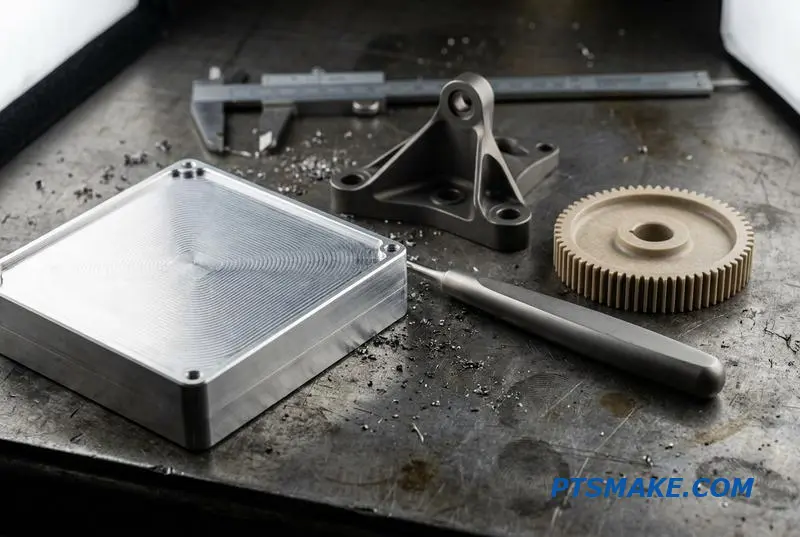
Selecting the best materials for precision machining requires a deeper look into how they behave on the machine. Factors like machinability ratings and cost impact are not just numbers; they translate into real-world project outcomes. At PTSMAKE, we guide our clients through this decision daily.
Comparing Metals for Precision Machining
Aluminum alloys like 6061 and 7075 are popular choices. 6061 is cost-effective and machines easily, perfect for general-purpose parts. 7075 offers superior strength, ideal for high-stress applications in aerospace, though it’s more challenging to machine. Stainless steel (304/316) provides excellent durability but requires slower machining speeds, increasing cycle times and costs. Titanium is the premium option, unmatched in strength-to-weight but also the most demanding to machine. The properties of some materials, especially metals, can vary depending on their grain direction, a concept known as Anisotropy2.
Precision Machined Plastic Parts
Plastics also have a significant role. PEEK offers incredible thermal and chemical resistance, making it a metal replacement in harsh environments. Delrin is a great choice for parts needing high stiffness and low friction, like gears. PTFE provides exceptional chemical resistance and a low coefficient of friction.
| Material Group | Machinability | Relative Cost | Best For |
|---|---|---|---|
| Aluminum Alloys | Excellent | Low | Prototyping, Structural Parts |
| Stainless Steels | Moderate | Medium | Durability, Corrosion Resistance |
| Titanium | Difficult | High | High-Stress, Lightweight Parts |
| Engineering Plastics | Varies | Medium-High | Specific Chemical/Thermal Needs |
Ultimately, the best material depends on your specific application requirements. There is no single "best" option. Balancing performance needs with budget and manufacturing feasibility is key to achieving optimal results in precision CNC machining.
The Complete Cost Breakdown: What Drives Precision CNC Machining Pricing?
Understanding the true cost drivers behind precision CNC machining is key to managing budgets. The price isn’t just about raw materials. It’s a complex calculation involving machine time, labor, and the specific requirements of your part. Every project is unique, requiring a custom assessment.
Core Cost Factors
The final quote you receive is built on several fundamental elements. Each contributes significantly to the total price, and understanding them helps you see where your money is going. Overlooking these can lead to unexpected expenses.
Material and Machine Time
Your choice of material directly impacts cost through its purchase price and machinability. Harder materials require more machine time and specialized tooling, driving up the CNC machining price per hour.
| Material | Relative Cost | Machinability |
|---|---|---|
| Aluminum 6061 | Low | Excellent |
| Stainless Steel 304 | Medium | Good |
| Titanium | High | Difficult |
| PEEK | Very High | Fair |
As you can see, a material like PEEK can be substantially more expensive to machine than a standard aluminum alloy.
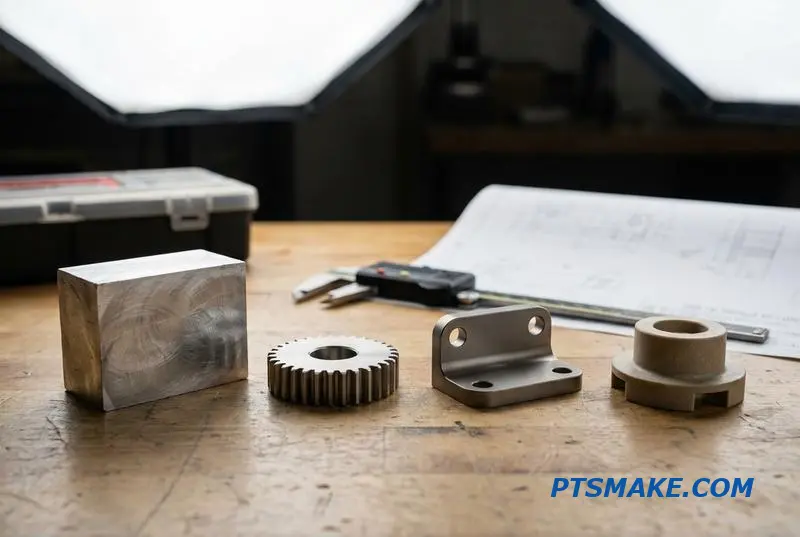
Beyond the obvious factors, several other elements can influence the final cost. These often relate to the complexity and precision required for the finished part. Ignoring them during the design phase is a common way to inadvertently increase production expenses later.
Advanced Cost Considerations
A part with complex geometries or extremely tight tolerances demands more from the machining process. This translates to higher programming time, specialized tooling, and more rigorous inspection, all of which add to the final cost. At PTSMAKE, we often work with clients on Design for Manufacturability (DFM).
Tooling, Finishing, and Inspection
Custom tooling is a significant, often overlooked, cost. If your design requires non-standard tools, these must be created, adding a one-time expense. Post-processing steps like anodizing, plating, or heat treating are also priced separately and add to the total.
Some exotic alloys are prone to Work hardening3 during machining. This phenomenon increases the material’s hardness, demanding slower cutting speeds and causing faster tool wear. This directly increases machine time and tooling costs, affecting the overall project budget.
How to Reduce CNC Machining Costs with DFM
Implementing DFM principles is the most effective way to lower costs. Simple adjustments can yield significant savings without compromising the part’s function.
| DFM Tip | Impact on Cost |
|---|---|
| Standardize hole sizes | Reduces tool changes and setup time |
| Increase corner radii | Allows for larger, more robust tools |
| Avoid thin walls | Minimizes vibration and potential part failure |
| Loosen non-critical tolerances | Reduces machine time and inspection needs |
Precision CNC machining pricing is multifaceted. Key drivers include material choice, machine time, setup complexity, and design features. Implementing Design for Manufacturability (DFM) principles is the most effective strategy for managing costs while maintaining quality for your precision parts.
3-Axis vs 5-Axis Precision CNC Machining: Which Do You Actually Need?
Choosing between 3-axis and 5-axis precision CNC machining is a frequent challenge. It’s not just about more axes; it’s about matching the right technology to your project’s needs. A 5-axis machine offers greater capability, but 3-axis machining is often more cost-effective for simpler geometries.
Key Differences at a Glance
The right choice balances complexity, cost, and lead time. Understanding their core differences is the first step toward making an informed decision for your parts.
Feature Comparison
A quick comparison shows distinct advantages for each process. This helps clarify where the value lies.
| Feature | 3-Axis Machining | 5-Axis Machining |
|---|---|---|
| Movement | X, Y, Z axes | X, Y, Z + A, B rotational axes |
| Best For | Simple, prismatic parts | Complex curves, undercuts |
| Setups | Multiple setups often needed | Single setup often possible |
| Cost | Lower hourly rate | Higher hourly rate |
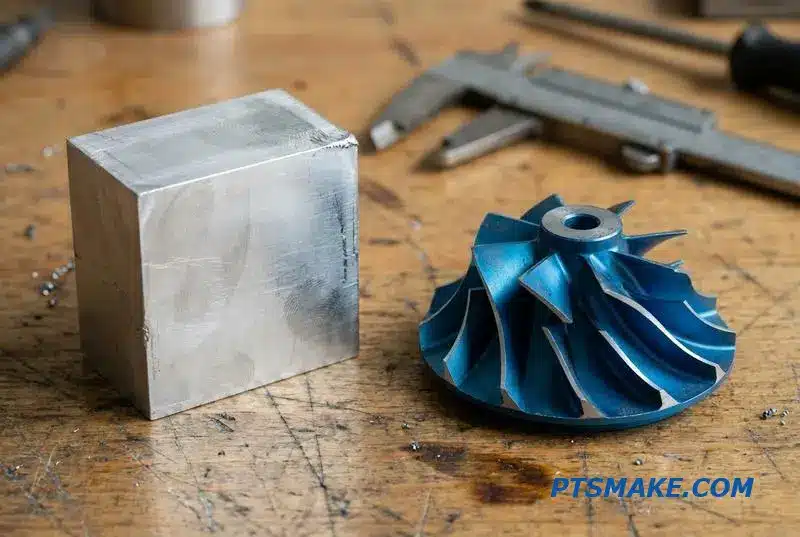
Deciding when to invest in 5-axis CNC machining requires looking beyond the initial cost. The primary benefit lies in its ability to produce highly complex geometries in a single setup. This is essential for parts like aerospace turbine blades or custom medical implants.
When 5-Axis Justifies the Cost
For components with compound curves and tight tolerances, 5-axis machining is not a luxury; it’s a necessity. By continuously adjusting the tool angle, it maintains optimal cutting conditions. This reduces tool wear and produces a superior surface finish, often eliminating the need for secondary polishing operations.
Setup Reduction and Accuracy
Fewer setups mean fewer opportunities for error. Each time a part is re-fixtured on a 3-axis machine, there’s a risk of misalignment. In multi-axis precision machining, completing a part in one clamping ensures features are perfectly aligned. This is critical for complex housings where port concentricity is vital. The machine’s Kinematics4 defines its precise motion capabilities.
Cost Per Part: The Real Metric
While the hourly rate for a 5-axis machine is higher, the total cost per part can be lower for complex components. Consolidating operations reduces labor, eliminates the need for complex fixtures, and shortens lead times.
| Part Example | Better with 3-Axis? | Better with 5-Axis? | Reason |
|---|---|---|---|
| Simple Bracket | Yes | No | Straightforward geometry, low cost |
| Medical Implant | No | Yes | Complex organic shapes, high accuracy |
| Turbine Blade | No | Yes | Aerodynamic curves, superior finish |
At PTSMAKE, we guide clients through this analysis to ensure the most efficient manufacturing process is chosen for every project.
Ultimately, the 3-axis vs 5-axis decision depends on your part’s complexity, required accuracy, and budget. 3-axis is ideal for simpler, cost-sensitive parts, while 5-axis excels at producing complex geometries with superior precision and finish in a single setup.
Surface Finish Options: Choosing The Right Finish For Your Application
Selecting the right surface finish for your parts is more than just an aesthetic choice. It directly impacts performance, durability, and cost. The ideal finish depends entirely on the application, from visual prototypes to functional, high-wear industrial components.
Functionality vs. Aesthetics
A common mistake is choosing a finish based only on looks. While a polished part looks great, it might not provide the corrosion resistance needed. We always guide our clients to balance visual requirements with functional needs like hardness or lubricity.
Understanding Ra Values
Surface roughness (Ra) is a critical specification in precision CNC machining. A lower Ra value indicates a smoother surface. The required Ra often dictates the finishing process, affecting both time and cost.
| Finish Type | Typical Ra (µm) | Primary Goal |
|---|---|---|
| As-Machined | 1.6 – 3.2 | Functional, non-cosmetic |
| Bead Blasting | > 3.2 | Uniform matte texture |
| Anodizing | 1.6 – 6.3 | Corrosion resistance |
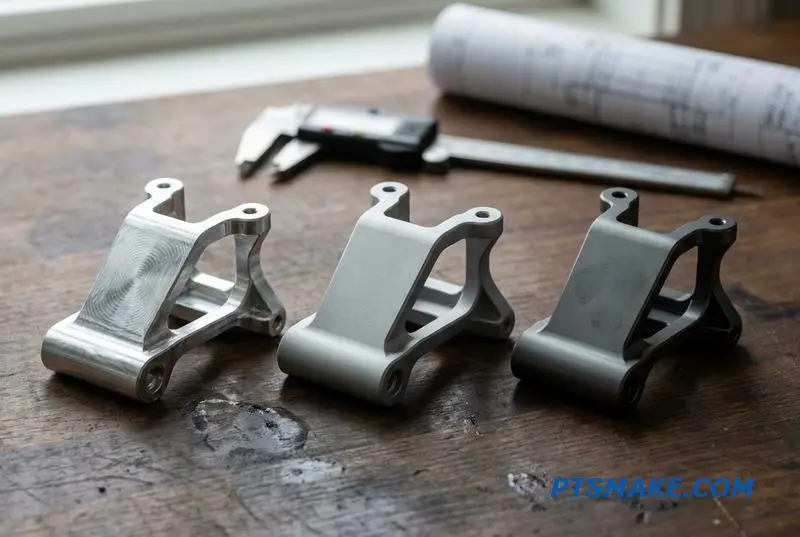
Choosing the optimal finish requires a detailed look at the trade-offs. Each option provides a unique combination of protection, appearance, and cost. Understanding these differences is key to successful part design and manufacturing.
Comparing Common Finishes
At PTSMAKE, we handle a variety of finishing requests. For aluminum parts, anodizing is a popular choice. Type II offers good corrosion resistance and color options for consumer electronics, while Type III (hardcoat) creates a durable, wear-resistant surface for industrial machinery. Bead blasting provides a uniform matte finish but offers no protective properties on its own.
Cost and Performance Impact
The cost of a finish can vary significantly. An as-machined finish is the most basic, while multi-step processes like powder coating or PVD are more expensive. We advise clients to consider the entire lifecycle cost, where a more expensive finish might prevent costly part failures down the line. This is especially true for projects that require enhanced Passivation5 to prevent environmental degradation over time.
| Finish | Primary Use | Relative Cost | Key Benefit |
|---|---|---|---|
| Bead Blasting | Aesthetics | Low | Uniform, non-directional texture |
| Anodizing (Type II) | Aesthetics & Corrosion | Medium | Color options, moderate protection |
| Powder Coating | Durability | Medium-High | High impact resistance |
| Electropolishing | Medical & Food | High | Ultra-smooth, cleanable surface |
Choosing the right finish balances aesthetics, function, and cost. From a basic as-machined surface to advanced coatings, each choice impacts the final performance and budget for your precision CNC machining project.
Design For Manufacturing: 10 Rules Engineers Must Follow For Precision Parts
Design for Manufacturing (DFM) is essential for creating high-quality, cost-effective precision parts. As an engineer, applying DFM principles bridges the gap between your design intent and the realities of production. It helps avoid unnecessary costs and delays by simplifying the manufacturing process from the start.
Key DFM Considerations
Focusing on a few core areas during the design phase has a significant impact. These include material selection, tolerance specification, and feature geometry. Proper DFM ensures your components are not just functional but also efficient to produce, especially for precision CNC machining.
Impact of DFM on Production
Optimizing your design for the machining process directly influences the final part’s quality and cost. Here is how small changes can lead to big improvements:
| DFM Principle | Design Choice (Poor) | Design Choice (Good) | Impact on Production |
|---|---|---|---|
| Wall Thickness | Thin, non-uniform walls | Uniform, thicker walls | Reduces vibration, improves stability |
| Internal Radii | Sharp internal corners | Radii > tool radius | Faster machining, lower tool stress |
| Hole Depth | Very deep, narrow holes | Depth < 4x diameter | Less tool breakage, faster drilling |
By following these guidelines, you make the manufacturing process smoother for partners like us at PTSMAKE and ultimately get better parts faster.
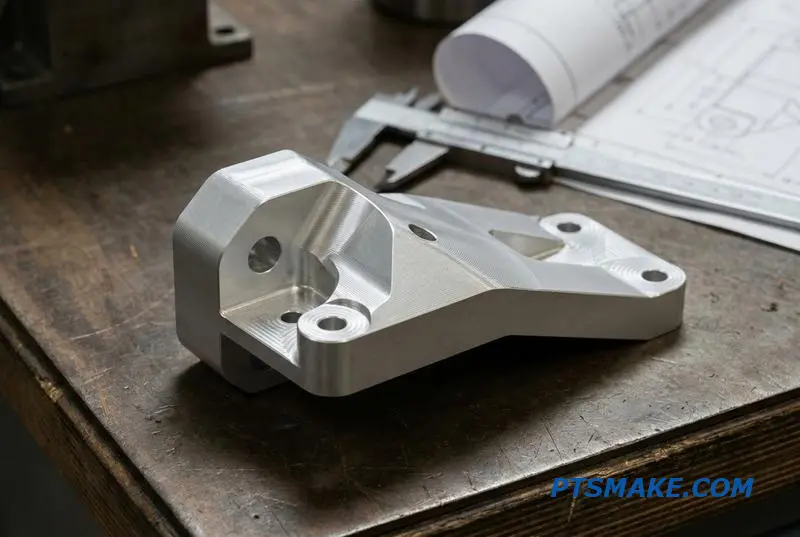
Let’s dive deeper into some specific rules that I often discuss with clients to optimize their designs for precision CNC machining. These practical tips can make a significant difference in the final product’s quality and your project’s budget.
Rule 1: Avoid Non-Standard Thread Specifications
Always try to use standard thread sizes in your designs. Custom threads require specialized tooling and extra setup time, which increases both cost and lead time. Sticking to standard specifications ensures tooling is readily available, simplifying the manufacturing process significantly.
Rule 2: Mind Your Hole Depths and Diameters
A common issue we see is holes designed to be too deep relative to their diameter. A good rule of thumb is to keep the depth of a hole to less than four times its diameter. Exceeding this ratio increases the risk of tool breakage and makes chip evacuation difficult.
Rule 3: Be Realistic with Geometric Dimensioning and Tolerancing6
While tight tolerances are necessary for precision parts, over-tolerancing is a costly mistake. Specify tight tolerances only where they are functionally critical. Unnecessarily tight tolerances require more complex machining operations, specialized inspection equipment, and higher scrap rates, driving up costs without adding value.
Here are some common do’s and don’ts:
| Feature | Do | Don’t |
|---|---|---|
| Threads | Use standard sizes (e.g., M6, 1/4-20) | Specify custom thread pitches |
| Holes | Keep depth-to-diameter ratio below 4:1 | Design deep, narrow blind holes |
| Tolerances | Apply tight tolerances only to critical features | Blanket the entire part with tight tolerances |
| Text | Use engraved (recessed) text | Specify raised (embossed) text |
Following these DFM rules for CNC machining ensures a smoother production process, lower costs, and higher-quality parts. By optimizing wall thickness, radii, holes, and tolerances, you align your design with manufacturing capabilities, preventing costly delays and rework.
Industry Applications: Where Precision CNC Machining Makes Or Breaks Projects
In high-stakes industries, precision is not a luxury; it’s a requirement. The success or failure of a project often hinges on components machined to exact specifications. A slight deviation can have catastrophic consequences, making supplier selection a critical decision for any project manager.
Aerospace and Medical Demands
For aerospace and medical applications, there is no margin for error. Components must withstand extreme conditions and meet stringent regulatory standards. In these fields, precision cnc machining ensures both safety and performance, from aircraft turbine blades to surgical implants.
Automotive and Robotics Performance
In the automotive and robotics sectors, precision translates to reliability and efficiency. High-performance engine parts or robotic arm components require tight tolerances for smooth operation and longevity. This level of accuracy prevents premature wear and ensures consistent performance over millions of cycles.
| Industry | Key Requirement | Common Material |
|---|---|---|
| Aerospace | High Strength-to-Weight Ratio | Titanium, Inconel |
| Medical Devices | Biocompatibility, Sterilizability | Stainless Steel 316L, PEEK |
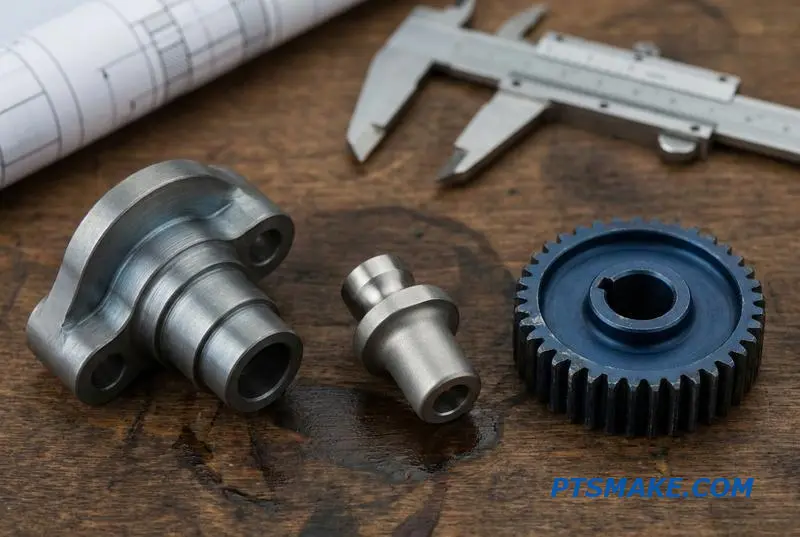
Choosing a manufacturing partner requires looking beyond their machine list. True expertise lies in understanding industry-specific nuances. For example, a supplier excelling in one area may not be suitable for another. At PTSMAKE, we have built our capabilities around these distinct demands.
Aerospace CNC Machining
In aerospace CNC machining, material traceability and certifications like AS9100 are non-negotiable. Parts often involve complex 5-axis machining of materials like titanium and Inconel. Tolerances are critical for components that experience high stress and temperature variations during flight.
Medical Device CNC Machining
For medical device CNC machining, the focus shifts to surface finish and material purity. We frequently work with biocompatible materials like PEEK and medical-grade stainless steel. Parts must be free of burrs and contaminants, as patient safety depends on their flawless integration. This involves a deep understanding of Biocompatibility7.
Robotics and Automotive Precision
Robotics precision parts and automotive precision machining demand repeatability and durability. We machine gears, shafts, and housings that must endure constant motion and wear. The challenge is maintaining tight tolerances across high-volume production runs while managing costs effectively.
| Sector | Critical Tolerance (Typical) | Certification Focus |
|---|---|---|
| Aerospace | ±0.005 mm | AS9100, NADCAP |
| Medical | ±0.010 mm | ISO 13485, FDA |
| Automotive | ±0.025 mm | IATF 16949 |
| Robotics | ±0.020 mm | ISO 9001 |
Selecting a supplier isn’t just about their technical capabilities. It’s about finding a partner with proven expertise in your specific industry. Their understanding of materials, certifications, and application demands is crucial for mitigating risk and ensuring your project’s success.
Prototype To Production: Scaling Precision CNC Machining Without Quality Loss
Moving from a single perfect prototype to full-scale production is where many projects face hurdles. The methods that create one flawless part often don’t translate to a thousand. Success requires a deliberate shift in mindset from proving a concept to ensuring repeatable excellence in precision CNC machining.
The Prototyping Mindset vs. Production Mindset
The focus during prototyping is flexibility and speed. For production, the priorities are repeatability, cost-efficiency, and consistency. This transition is a critical planning phase that requires careful consideration of several factors.
Key Differences in Approach
| Feature | Prototype Focus | Production Focus |
|---|---|---|
| Tooling | Standard, flexible setups | Custom fixtures, optimized tooling |
| Process | Manual adjustments, operator skill | Automated, validated processes |
| Inspection | 100% manual inspection | Statistical Process Control (SPC) |
| Goal | Validate design and function | Achieve consistency at scale |
Planning for this shift early is essential for a smooth ramp-up. We guide our partners through this process, ensuring the design is optimized not just for function but for scalable manufacturing from the very beginning.
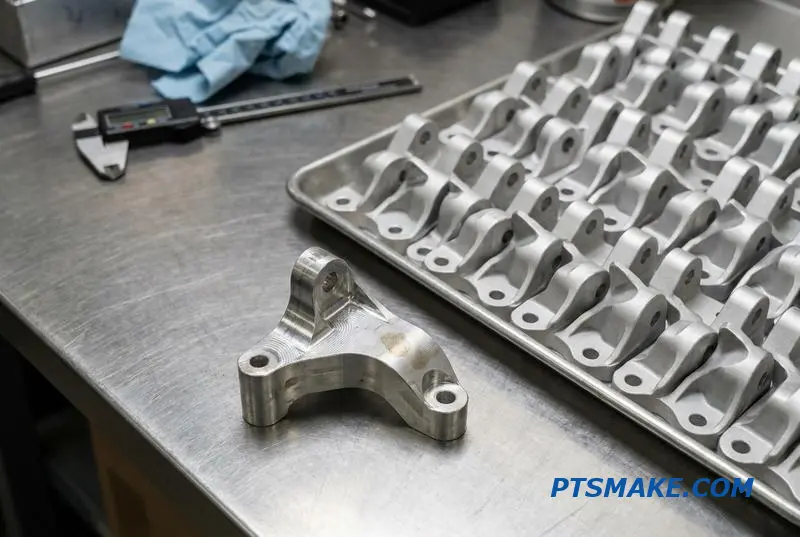
Scaling precision machining is more than just running machines longer; it’s about systemizing quality. The transition from CNC machining prototype to production introduces challenges that must be addressed proactively to prevent quality degradation and delays.
Process Validation and Investment
A validated process is one that consistently produces parts within specification. This involves establishing fixed parameters for machine speeds, feeds, tool paths, and quality checks. It’s a foundational step before starting any low volume CNC production run.
Fixturing: From Vice to Custom Jigs
While a standard vise is sufficient for a prototype, production requires robust fixturing. Investing in custom jigs ensures each workpiece is held in the exact same position, which is critical for maintaining tight tolerances across thousands of units. This investment pays for itself in reduced setup times and lower scrap rates.
| Stage | Fixturing Method | Primary Benefit |
|---|---|---|
| Prototype | Standard Vise / Clamps | Speed and Flexibility |
| Low Volume | Soft Jaws / Modular Fixtures | Improved Repeatability |
| High Production | Custom Hydraulic / Pneumatic Jigs | Maximum Speed & Consistency |
Ensuring Batch-to-Batch Consistency
Achieving consistency requires rigorous control over materials and processes. We implement material traceability and monitor tool wear closely. Furthermore, using metrics like the Process Capability Index (Cpk)8 helps us statistically verify that our process is stable and capable of meeting design requirements long before a full production run is launched. This data-driven approach is fundamental to scaling precision machining successfully.
Scaling from prototype to production demands a strategic focus on process validation, fixturing, and supplier capability. This proactive planning is essential to maintain the quality and precision established in the initial stages, ensuring a seamless and cost-effective manufacturing ramp-up.
Put your precision knowledge into action with PTSMAKE.
This guide showed you the complexities of precision machining. Let us simplify it for you. As your trusted partner from prototype to production, we eliminate supplier uncertainty with guaranteed precision and reliability. Challenge our expertise—send your design for a fast, competitive quote today.

Explore how the science of measurement ensures your parts meet exact specifications and functional requirements. ↩
Understand how this material property influences machining strategies and final part precision. ↩
Understanding this property helps predict material behavior, preventing unexpected tool wear and cost increases. ↩
Understanding this concept helps clarify how machine movements create complex part geometries. ↩
Learn how this chemical process enhances material durability and corrosion resistance in engineering applications. ↩
Explore this system to precisely define and control part geometry, ensuring functional and assembly requirements are met. ↩
Understand how material choice directly influences patient safety and the success of medical devices. ↩
Understand this metric to predict your production quality and process stability before committing to scale. ↩