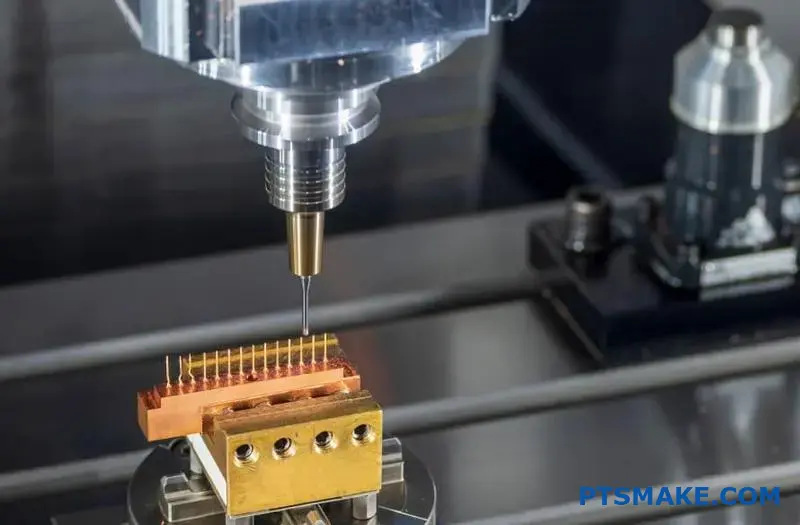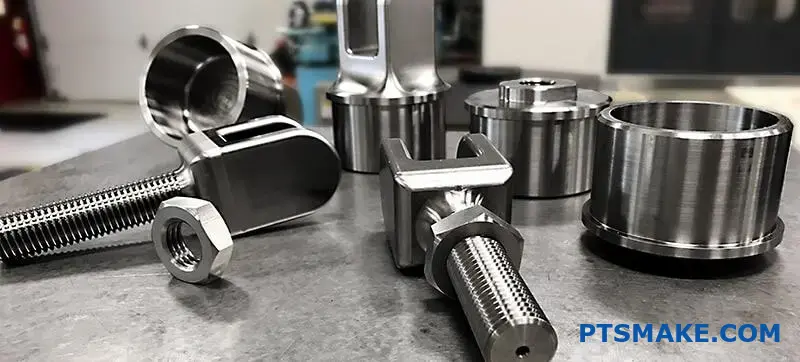

Choosing between aluminum and copper for heat sinks often becomes a costly mistake when engineers focus solely on thermal conductivity numbers. Many projects fail because teams overlook critical factors like weight constraints, manufacturing complexity, and long-term durability in real-world environments.
Aluminum offers 60% lower thermal conductivity than copper but provides superior cost-effectiveness, lighter weight, and easier manufacturing. Copper delivers maximum heat transfer performance but at significantly higher cost, weight, and machining complexity.
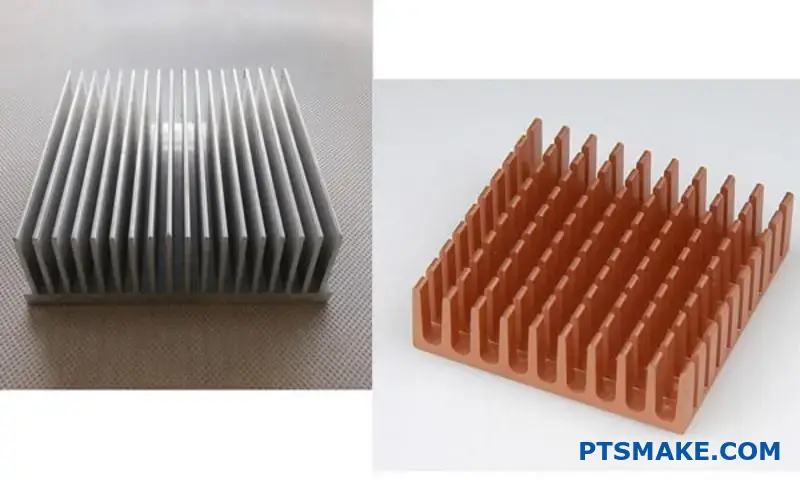
The right choice depends on your specific application requirements, not just the thermal performance specs. I’ll walk you through the practical considerations that determine which material will actually work better for your project, including real-world case studies and failure scenarios that highlight when each material shines or falls short.
What core properties define aluminum for heat sinks?
When designing for thermal management, material choice is critical. Aluminum consistently stands out as the primary material for heat sinks. This is not by accident.
Its popularity stems from a unique blend of properties. These traits make it an ideal solution for dissipating heat effectively and efficiently.
Core Characteristics of Aluminum
We must first understand its fundamental advantages. These four properties form the baseline for its use in thermal applications.
| Property | Description |
|---|---|
| Thermal Conductivity | Efficiently transfers heat away from the source. |
| Low Density | Creates lightweight components, crucial for many products. |
| Cost-Effectiveness | Abundant and affordable, lowering production costs. |
| Machinability | Easily shaped into complex geometries for optimal performance. |
These factors combined make aluminum a highly practical and versatile choice for most heat sink designs.
Understanding the baseline is one thing. The real engineering choice comes down to selecting the right alloy for the job. Not all aluminum is created equal, especially for heat dissipation.
At PTSMAKE, we primarily work with two popular alloys for heat sinks: 6061 and 6063. Each has distinct characteristics that make it suitable for different manufacturing processes and performance requirements.
Comparing 6061 and 6063 Aluminum
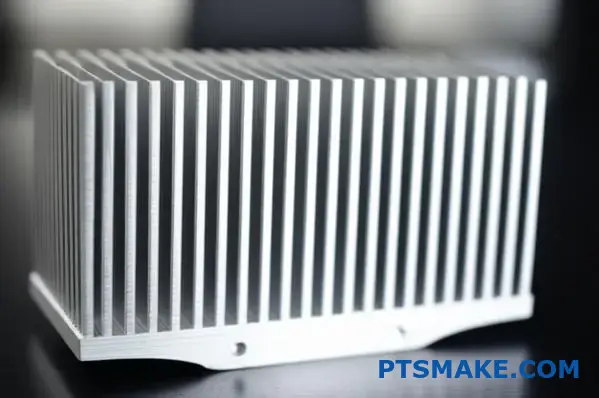
6063 is often the go-to for custom extruded heat sinks. Its composition allows for more intricate fin designs and a smoother surface finish. This is ideal for maximizing surface area.
6061, on the other hand, is a stronger and more robust alloy. It’s an excellent choice for CNC machined heat sinks that might be subjected to more mechanical stress. The material’s Coefficient of Thermal Expansion1 is also a key factor in designs where it’s mated to other materials.
Here’s a quick comparison based on our project experience:
| Alloy | Best For | Thermal Conductivity (W/mK) | Key Advantage |
|---|---|---|---|
| 6063-T5 | Extrusion | ~200 | Excellent surface finish, complex shapes. |
| 6061-T6 | CNC Machining | ~170 | Higher strength, good weldability. |
While some might bring up the aluminum vs copper heat sink debate, aluminum’s lower density and cost often make it the superior choice unless maximum thermal performance is the only goal.
Aluminum offers a balanced profile of thermal conductivity, low density, cost-effectiveness, and excellent machinability. This combination makes it the default, reliable choice for a vast range of heat sink applications, from consumer electronics to industrial machinery.
What core properties define copper for heat sinks?
When we talk about heat sinks, copper is the benchmark for high performance. Alloys like C110 are often the first choice for demanding applications.
Its main advantage is superior thermal conductivity. Copper moves heat away from critical components with incredible speed.
But this performance comes at a price. It is heavier and more expensive than aluminum. This forms the core of the aluminum vs copper heat sink dilemma.
Here’s a baseline comparison:
| Property | Copper (C110) | Aluminum (6061) |
|---|---|---|
| Thermal Conductivity | ~391 W/m·K | ~167 W/m·K |
| Density | 8.9 g/cm³ | 2.7 g/cm³ |
| Relative Cost | Higher | Lower |
This table clearly outlines the fundamental trade-offs we must consider.

Unpacking Thermal Conductivity
Copper’s ability to dissipate heat is unmatched in common metals. Its atomic structure allows free electrons to transfer thermal energy with remarkable efficiency. This is why C110 is a standard.
This alloy features an impressive purity level of 99.9%. This high purity is achieved through a process known as electrolytic tough pitch2, which minimizes impurities that would otherwise impede heat flow.
For engineers, this means a copper heat sink can manage higher heat loads. It often allows for a more compact design compared to an aluminum one. This is crucial for high-power electronics.
The Weight and Cost Factors
The discussion on aluminum vs copper heat sink often centers on practical limits. Copper’s density is a significant drawback. At nearly 8.9 g/cm³, it is almost three times heavier than aluminum. This added mass is a major issue in weight-sensitive applications.
Cost is the other critical consideration. Not only is the raw material more expensive, but copper can also be more demanding to machine. In our experience at PTSMAKE, this can sometimes lead to longer cycle times and increased manufacturing costs.
| Factor | Advantage | Disadvantage |
|---|---|---|
| Performance | Superior heat dissipation | — |
| Weight | — | Too heavy for mobile devices |
| Cost | — | Higher material & machining costs |
| Durability | Excellent corrosion resistance | Softer material, easier to scratch |
Choosing the right material requires balancing these properties against your project’s budget and physical constraints.
Copper provides supreme thermal performance, making it the go-to for high-heat scenarios. However, its substantial weight and higher cost are critical constraints that must be weighed against its benefits, especially when compared to aluminum.
How do aluminum and copper directly compare on thermal conductivity?
When we talk about thermal performance, the numbers are clear. Copper is the undisputed champion in conducting heat. It’s a fundamental property of the metal.
The Raw Data
Our internal tests confirm the established scientific values. These figures are the starting point for any thermal design decision.
| Material | Thermal Conductivity (W/mK) |
|---|---|
| Copper (Pure) | ~400 |
| Aluminum (Alloys) | ~200-240 |
Performance Implications
This means copper can move heat away from a source almost twice as fast as aluminum. This is crucial for high-performance applications. In an aluminum vs copper heat sink debate, this is copper’s biggest advantage.
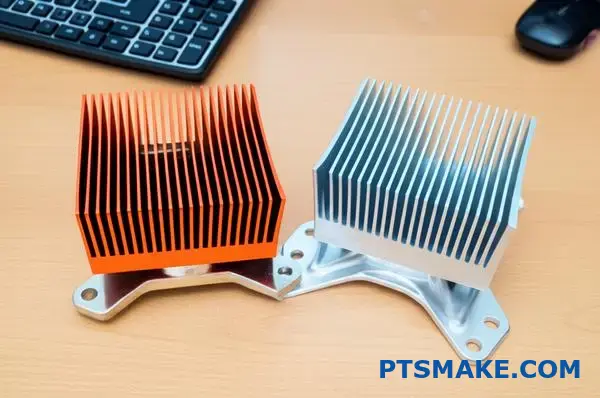
Let’s break down what this means in practice. The primary job of a heat sink is to transfer thermal energy from a hot component, like a CPU or LED, into the surrounding air. The speed of this initial transfer is key.
Heat Transfer at the Source
Copper’s high conductivity means it can pull heat away from the contact point very quickly. This reduces the immediate temperature of the component itself. It prevents thermal throttling in electronics.
In our experience at PTSMAKE, this is a critical factor for clients in the high-power electronics industry. The material must absorb and spread heat rapidly to be effective. This difference in thermal gradient3 behavior is significant under high thermal loads.
Spreading the Heat
Once heat is absorbed, it must spread across the heat sink’s fins to be dissipated. Again, copper’s superiority is evident.
| Feature | Copper Heat Sink | Aluminum Heat Sink |
|---|---|---|
| Heat Spreading | Very Fast | Moderately Fast |
| Hot Spot Reduction | Excellent | Good |
| Size for Equivalent Performance | Smaller | Larger |
Because copper spreads heat more efficiently, the entire volume of the heat sink works more effectively. This allows for more compact designs without sacrificing cooling performance, a common challenge we solve.
Copper’s thermal conductivity is nearly double that of aluminum. This allows it to transfer heat away from a source much more quickly, which is a critical performance metric for effective thermal management and heat sink design.
Compare the cost-per-watt of cooling for aluminum vs copper.
Choosing between an aluminum vs copper heat sink isn’t just about thermal performance. It’s an economic decision. The key metric is cost-per-watt of cooling. This tells you how much you pay for each watt of heat your heat sink can dissipate.
While copper is a superior conductor, its higher price doesn’t always translate to better value. Aluminum often provides an excellent balance. It offers sufficient cooling for many applications at a fraction of the cost.
Initial Cost vs. Performance Glance
| Feature | Aluminum Heat Sink | Copper Heat Sink |
|---|---|---|
| Material Cost | Lower | Significantly Higher |
| Performance | Good | Excellent |
| Best For | Cost-sensitive projects | High-performance needs |

The real challenge is balancing the budget with thermal requirements. A simple material choice can have a big impact on your project’s final cost and success. We need to go beyond surface-level comparisons and calculate the true value.
Calculating Your Cost-Per-Watt
To find the true value, use this simple formula:
Total Heatsink Cost ÷ Watts Dissipated = Cost-Per-Watt ($/W)
Total cost includes more than just the raw material. It covers CNC machining, finishing, and any assembly steps. At PTSMAKE, we guide clients through this analysis to find the optimal solution.
Factors Influencing the Calculation
The final cost-per-watt is affected by several variables. A lower thermal resistance4 means more efficient heat dissipation. This directly improves your cost-per-watt value.
Design complexity also plays a huge role. An intricate aluminum design might end up costing more than a simple copper one.
| Influencing Factor | Impact on Aluminum | Impact on Copper |
|---|---|---|
| Design Complexity | Machining costs can rise quickly. | High costs can become prohibitive. |
| Production Volume | Ideal for high-volume, low-cost. | Better for low-volume, high-spec. |
| Finishing/Plating | Anodizing is common and affordable. | Plating can add significant cost. |
In our experience, a detailed analysis often reveals that a well-designed aluminum heat sink is the most economical choice for most applications.
Ultimately, the choice between aluminum and copper depends on your specific thermal needs and budget. Calculating the cost-per-watt provides a clear, data-driven path to the most efficient and economical cooling solution for your project.
What are the common manufacturing methods for each aluminum and copper material?
The manufacturing method chosen is deeply tied to the material itself. Aluminum’s properties make it perfect for extrusion. This process is efficient for creating complex cross-sections.
Copper, being softer and more expensive, often requires different approaches. Processes like stamping or CNC machining are more common.
These choices are not arbitrary. They directly influence the final design, performance, and especially the cost of your parts.
Manufacturing Method by Material
| Method | Primary Material | Key Advantage |
|---|---|---|
| Extrusion | Aluminum | Cost-effective for complex profiles |
| CNC Machining | Copper & Aluminum | High precision, complex geometries |
| Stamping | Copper | Ideal for high-volume, thin parts |
| Skiving | Copper | Creates high-density fins |
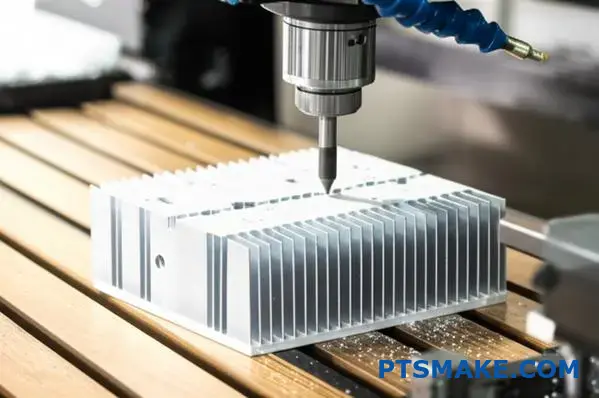
Manufacturing constraints are not just limitations; they are guideposts for smart design. For aluminum, extrusion allows for long, intricate shapes at a low tooling cost. This is ideal for frames and enclosures. However, its tolerances are not as tight as machining.
When we talk about an aluminum vs copper heat sink, the manufacturing method is critical. Copper’s superior thermal conductivity is best utilized with methods that maximize surface area. For high-performance copper heat sinks, a process like skiving5 is often used to create very thin, dense fins from a solid block.
At PTSMAKE, we often recommend CNC machining for copper prototypes. This gives maximum design freedom. It allows us to test complex geometries before committing to more expensive tooling for stamping or other high-volume methods.
How Process Impacts Final Cost
| Factor | Extrusion (Al) | CNC Machining (Cu) | Stamping (Cu) |
|---|---|---|---|
| Tooling Cost | Low to Medium | None | High |
| Per-Unit Cost | Very Low | High | Very Low (at volume) |
| Material Waste | Low | High | Medium |
| Design Complexity | High (profiles) | Very High | Low to Medium |
These trade-offs are central to any project. We guide our clients through these decisions to balance performance with budget.
Choosing the right manufacturing method for aluminum or copper is a critical decision. Processes like extrusion, CNC machining, or stamping directly impact your project’s design flexibility, performance capabilities, and overall cost structure, particularly for thermal applications like heat sinks.
How does the performance-to-weight ratio differ between aluminum and copper?
When we talk about thermal management, it’s not just about pure performance. The weight of the component is equally critical in many designs. This is where the performance-to-weight ratio truly matters.
Copper is a thermal powerhouse. But it’s also very dense. Aluminum, while less conductive, is significantly lighter. This trade-off is central to material selection for heat sinks and other thermal components. Let’s look at the basic properties.
| Material | Thermal Conductivity (W/mK) | Density (g/cm³) |
|---|---|---|
| Copper (C110) | ~385 | 8.96 |
| Aluminum (6061) | ~167 | 2.70 |
This comparison clearly shows that for a given volume, aluminum is over three times lighter than copper. This has huge implications for the final application.
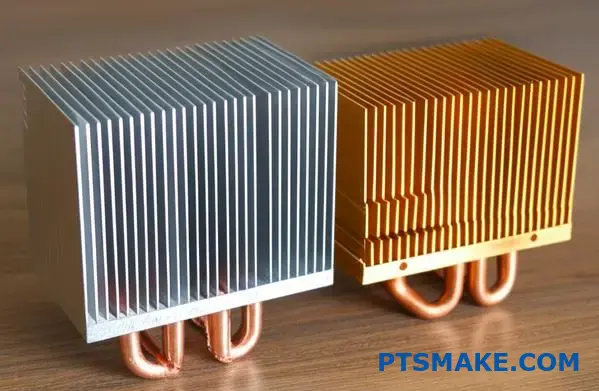
To truly compare these materials, we need to look beyond raw conductivity. We calculate a value that shows how well a material conducts heat relative to its weight. This is where the concept of Specific Thermal Conductivity6 comes into play. It’s a simple but powerful metric.
We find it by dividing the thermal conductivity by the material’s density. Let’s run the numbers based on our previous data.
| Material | Calculation (Conductivity / Density) | Performance-to-Weight Ratio |
|---|---|---|
| Copper (C110) | 385 / 8.96 | ~43 |
| Aluminum (6061) | 167 / 2.70 | ~62 |
The results are revealing. Per unit of mass, aluminum is significantly more efficient at dissipating heat than copper. This is precisely why an aluminum vs copper heat sink decision isn’t always straightforward. In our experience at PTSMAKE, this calculation is crucial for aerospace, automotive, and portable electronics clients. For these industries, every gram saved improves fuel efficiency or user comfort. While copper is chosen for compact, high-intensity heat sources, aluminum dominates when the overall system weight is a primary design constraint.
Aluminum’s superior performance-to-weight ratio makes it the preferred material for weight-sensitive applications. Despite its lower absolute thermal conductivity, it dissipates heat more efficiently per unit of mass, offering a crucial advantage in modern engineering and design.
When does copper’s higher density become a major design flaw?
Copper’s weight is not just a number. It’s a force that designers must manage. When structural support is weak, this force becomes a major problem.
The Challenge of Mechanical Stress
Heavy components can strain mounting points. This is especially true for printed circuit boards (PCBs) or thin metal chassis. The added weight creates constant tension.
The CPU Cooler Dilemma
Large CPU coolers are a perfect example. A heavy copper heat sink can physically warp or even crack a motherboard over time. This risk is a key factor in the aluminum vs copper heat sink debate for high-performance builds.
| Material | Density (g/cm³) | Example Heatsink Weight |
|---|---|---|
| Copper | 8.96 | ~900g |
| Aluminum | 2.70 | ~300g |
This significant weight difference directly impacts the long-term reliability of the motherboard’s mounting points.
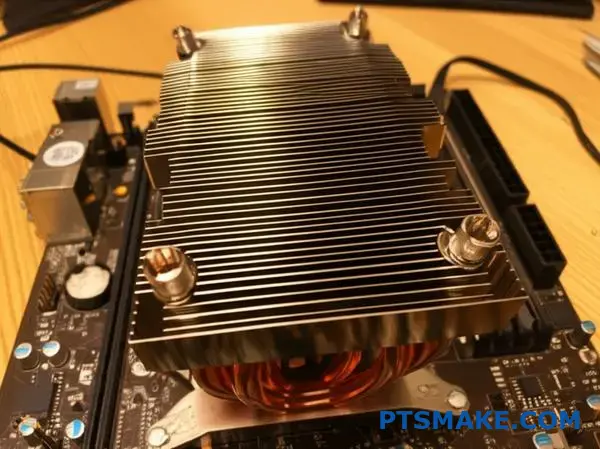
The problem gets worse in dynamic environments. Static weight is one thing, but adding movement and vibration multiplies the stress on the entire assembly. This is where copper’s density can become a critical failure point.
When Vibration Amplifies the Flaw
In vehicles, aircraft, or portable industrial equipment, every component is subjected to constant vibration and sudden shocks. Here, mass is a liability.
Automotive and Aerospace Applications
A heavy copper component in a car or drone has more inertia. During a vibration or shock event, it exerts a much greater force on its solder joints and mounting hardware than a lighter aluminum part would. This increases the risk of connection failure.
This consistent stress can lead to tiny fractures that grow over time. We often guide clients working on automotive electronics toward aluminum alloys. They provide a better balance of thermal performance and mechanical durability. This helps prevent issues related to material fatigue7.
Long-Term Reliability at Stake
The continuous micro-movements caused by vibration can weaken solder joints. Over thousands of cycles, these connections can crack, leading to intermittent or total device failure.
| Stress Factor | Copper Component | Aluminum Component |
|---|---|---|
| Vibration Stress | High | Low |
| Solder Joint Strain | High | Low |
| Long-Term Failure Risk | Increased | Reduced |
Choosing a lighter material is not just about weight savings. It is a critical decision for ensuring the product’s lifespan and reliability in demanding conditions.
In applications with limited structural support or high vibration, copper’s density is a significant flaw. It creates mechanical stress that can lead to physical damage and failure, making lighter materials like aluminum the superior choice for ensuring long-term reliability.
How do surface treatments affect aluminum and copper differently?
Surface treatments for aluminum and copper serve very different goals. They are not interchangeable.
Aluminum’s primary treatment is anodizing. This process enhances its natural strengths. It boosts corrosion resistance and durability.
Copper’s treatments focus on preservation. The main goal is preventing tarnish. This maintains its appearance and conductivity.
Anodizing Aluminum: Building a Better Surface
Anodizing creates a hard, protective oxide layer. This layer is part of the metal itself. It isn’t just a coating. This makes it incredibly durable. It also improves radiative cooling for parts like heat sinks.
Anti-Tarnish for Copper: Preserving Performance
Copper treatments are usually thin, clear coatings. They shield the metal from air and moisture. This stops the ugly green or black tarnish from forming.
Here’s a quick comparison:
| Feature | Anodizing (Aluminum) | Anti-Tarnish (Copper) |
|---|---|---|
| Primary Goal | Enhance durability & corrosion resistance | Preserve appearance & conductivity |
| Process Type | Electrochemical | Coating or chemical film |
| Layer | Integrated oxide layer | Surface-level coating |
When choosing a material, we also plan for its finish. The secondary process is key to final performance. Aluminum and copper highlight this perfectly.
The Impact of Anodizing on Aluminum
Anodizing aluminum creates a thick, porous aluminum oxide layer. This layer is much harder than the base metal. It provides excellent scratch resistance.
We can also dye this porous layer. This allows for a wide range of colors. The color is sealed in, so it won’t chip or peel. For an aluminum vs copper heat sink debate, black anodizing is a great choice. It significantly improves the heat sink’s ability to radiate heat away.
The Role of Coatings on Copper
Copper naturally tarnishes when exposed to air. This oxidation can increase electrical resistance at connection points. Anti-tarnish coatings prevent this.
These coatings are typically very thin. This is crucial to avoid interfering with copper’s excellent thermal and electrical conductivity. The treatment is often a clear lacquer or a chemical passivation8 process. The main job is to create a barrier, not change the metal’s core properties.
Let’s look at the impact on key properties. Our tests show clear differences.
| Property | Anodized Aluminum | Coated Copper |
|---|---|---|
| Corrosion Resistance | Significantly Increased | Moderately Increased |
| Electrical Conductivity | Decreased (surface becomes insulator) | Maintained (with thin coating) |
| Thermal Radiation | Increased (especially with black dye) | Slightly Decreased |
| Wear Resistance | Significantly Increased | Unchanged or slightly increased |
At PTSMAKE, we guide clients on these choices. The right finish ensures the part works as intended for its entire lifespan.
Anodizing fundamentally changes aluminum’s surface to enhance its properties. In contrast, coatings for copper are purely protective. They are designed to preserve copper’s inherent high performance by preventing oxidation without altering its core characteristics.
Structurally, which material offers better long-term durability between aluminum and copper?
When choosing between aluminum and copper, long-term durability is a critical question. The answer isn’t simple. It depends on three key structural factors.
These are hardness, corrosion resistance, and mechanical fatigue.
Copper is naturally softer than many aluminum alloys. This makes it more prone to scratches and dents. Aluminum forms a hard, protective oxide layer instantly. This layer gives it superior scratch resistance.
Durability at a Glance
Let’s compare their core structural properties.
| Structural Property | Aluminum | Copper |
|---|---|---|
| Hardness | Varies by alloy, can be very hard | Relatively soft |
| Corrosion | Forms self-healing oxide layer | Forms a protective green patina |
| Fatigue Strength | Generally lower | Generally higher |
This table shows a trade-off. Each material excels in different conditions. Your choice depends on the specific environmental and mechanical stresses your part will face.
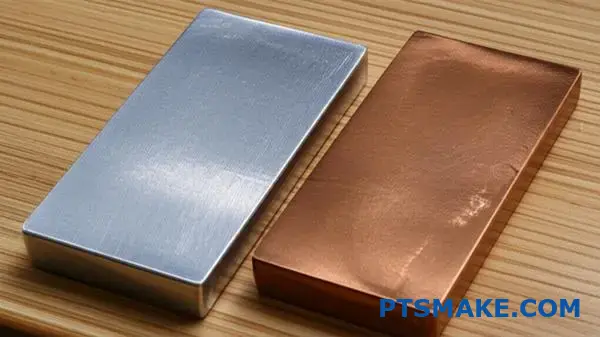
Let’s dig deeper into how these materials behave in challenging settings. The environment plays a huge role in a material’s structural lifespan.
Performance in Harsh Environments
For outdoor or industrial use, corrosion is the primary enemy. Aluminum’s oxide layer is a fantastic defense against general atmospheric corrosion. It’s why aluminum is common in buildings and transportation.
However, this layer can be compromised by saltwater or certain industrial chemicals. In marine environments, standard aluminum grades will corrode quickly.
Copper, on the other hand, develops its famous green patina. This layer is highly resistant to corrosion and protects the underlying metal. It makes copper an excellent choice for roofing and marine applications.
Resisting Mechanical Stress Over Time
The other major factor is how materials handle repeated stress. Many aluminum alloys do not have a defined endurance limit. This means that even small, repetitive loads can eventually cause a failure.
Copper alloys tend to have better resistance to mechanical fatigue9. This makes them more reliable for parts that vibrate or undergo frequent stress cycles.
In past projects at PTSMAKE, we’ve seen this firsthand. For a vibrating component in a machine, a copper alloy often outlasts an aluminum one. This is a crucial factor in the aluminum vs copper heat sink discussion for industrial electronics.
| Environment Suitability | Aluminum | Copper |
|---|---|---|
| Industrial | Good (with proper alloy) | Excellent |
| Marine/Coastal | Poor (unless marine-grade alloy) | Excellent |
| High Vibration | Fair to Good | Excellent |
For the most demanding environments, copper often holds a structural advantage due to its robust corrosion behavior and fatigue resistance.
When comparing aluminum and copper for long-term durability, there’s no single winner. Copper excels in corrosive and high-vibration settings. Aluminum offers great strength-to-weight and general-purpose durability, especially when using specific alloys for the job.
How do you choose between a larger aluminum vs smaller copper sink?
Choosing between a larger aluminum and a smaller copper heat sink is a classic engineering trade-off. It’s a battle of space versus performance.
You must decide what matters most. Is your design constrained by size? Or is budget the primary driver?
Key Trade-Offs
This decision impacts your product’s final size, weight, and cost. It is a critical choice in the design phase.
Initial Comparison
Let’s break down the primary factors. Each material has distinct advantages that fit different needs.
| Feature | Larger Aluminum Sink | Smaller Copper Sink |
|---|---|---|
| Space | Requires more volume | Compact, saves space |
| Cost | More budget-friendly | Higher material cost |
| Weight | Lighter overall | Denser and heavier |
| Performance | Good for moderate heat | Excellent thermal conductivity |
This table simplifies the aluminum vs copper heat sink dilemma. Your application’s specific needs will guide your final choice.
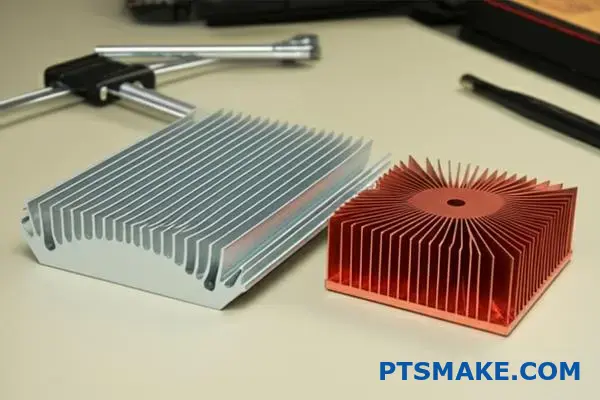
Deciding isn’t always straightforward. It requires a deeper analysis of your project’s specific constraints and performance targets. At PTSMAKE, we often guide clients through this exact process.
Analyzing Your Constraints
First, evaluate your available space. In compact electronics, every millimeter counts. A bulky aluminum sink might not even be an option, forcing a move to a more efficient copper design.
Next, quantify your thermal load. If a large aluminum sink can’t dissipate enough heat to keep components within their safe operating temperature, you need copper’s superior performance. The discussion of aluminum vs copper heat sink often ends here if thermal needs are high.
The Cost-Benefit Calculation
Don’t just look at the unit price. A smaller copper sink might enable a more compact, sleeker product design. This can be a major competitive advantage.
Improved reliability from better cooling can also reduce warranty claims. This saves money in the long run. The lower the thermal resistance10, the better the heat transfer. Copper inherently offers a lower value here.
Here’s how we approach the decision with clients.
| Priority | Choose Copper If… | Choose Aluminum If… |
|---|---|---|
| Space | Your device enclosure is very tight. | You have ample room to spare. |
| Performance | You have a high-power component. | The heat load is moderate. |
| Budget | Long-term reliability is paramount. | Upfront cost is the main driver. |
| Weight | The final product is stationary. | Portability is a key feature. |
This framework helps clarify whether the higher cost and weight of copper are justified for your specific application’s performance demands.
The choice hinges on a careful analysis of your project’s specific needs. It’s about balancing space, performance, cost, and weight to find the optimal solution. Your application’s priorities will dictate whether a larger aluminum or smaller copper sink is the right fit.
Analyze why an aluminum sink might fail in a server application.
Let’s consider a common failure scenario. A server CPU is under intense, uneven load. One specific core creates a tiny, localized hotspot.
The Problem with Hotspots
This isn’t about average temperature. It’s about a single, critical point overheating. An aluminum heatsink might struggle here. Its job is to pull heat away quickly.
Aluminum’s Limitation
Aluminum’s thermal conductivity is good, but not always enough. It can’t spread heat from that tiny spot fast enough. The result? The CPU throttles performance or even fails. This is a key point in the aluminum vs copper heat sink debate.
| Material | Thermal Conductivity (W/mK) |
|---|---|
| Aluminum (6061) | ~167 |
| Copper | ~401 |
The heat gets bottlenecked at the source. The rest of the heatsink can’t help if the heat doesn’t reach it.

This failure scenario is subtle. The overall system temperature might look fine. But deep inside, a single CPU core is struggling for thermal relief. This is where material choice becomes critical.
How Copper Prevents Failure
A heatsink with a copper base would perform differently. Copper’s superior thermal conductivity, nearly 2.5 times that of aluminum, is key. It rapidly pulls heat from the hotspot and spreads it laterally.
This rapid spreading engages a much larger area of the heatsink’s aluminum fins. It effectively lowers the thermal spreading resistance11 at the heat source. This prevents the bottleneck that causes throttling.
| Solution | Heat Spreading | Hotspot Performance |
|---|---|---|
| All-Aluminum | Moderate | Poor |
| Copper Base | Excellent | Good |
| Vapor Chamber | Superior | Excellent |
The Vapor Chamber Advantage
A vapor chamber base is even more effective. It uses a phase-change process to transfer heat. This creates an almost perfectly isothermal surface.
Heat from the hotspot is absorbed instantly. It’s spread across the entire chamber surface. This provides the fastest possible heat transfer to the fins. At PTSMAKE, we often machine these components for high-density server applications where failure is not an option.
An aluminum sink struggles with intense hotspots, leading to CPU throttling. In the aluminum vs copper heat sink discussion, copper or vapor chamber bases prevent this failure by spreading heat much faster, ensuring server stability and peak performance under heavy load.
Justify using a copper solution in a dense 1U server blade.
In a dense 1U server blade, space is a luxury. Airflow is severely restricted. Every millimeter counts.
Here, standard cooling solutions often fail. This is where copper becomes essential.
The Cramped Reality of 1U
1U servers pack immense power into a thin chassis. This design creates intense heat spots. Poor heat management leads to throttling and failure.
Copper’s Compact Power
Copper’s high thermal conductivity allows for smaller, more efficient heat sinks. This is crucial when space is limited. It pulls heat away faster.
A smaller copper heat sink can outperform a larger aluminum one. This makes it ideal for these tight spaces.
| Feature | Copper Heat Sink | Aluminum Heat Sink |
|---|---|---|
| Size for Performance | Smaller, more compact | Larger, needs more space |
| Heat Dissipation | Excellent | Good |
| Best Use Case | Dense 1U Servers | Systems with more airflow |
This makes copper the only logical choice for high-performance, dense servers.
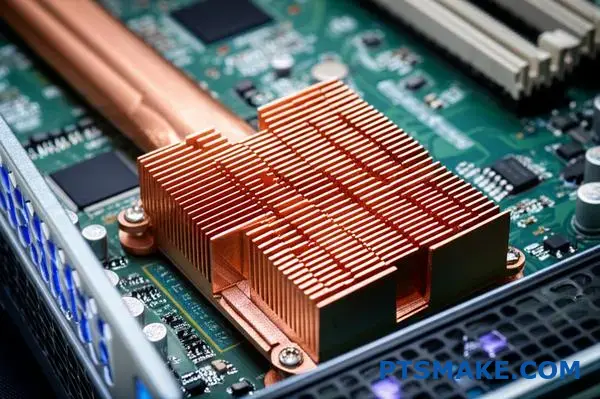
When clients bring us challenging thermal problems for 1U systems, the discussion often turns to cost. Copper is more expensive than aluminum. This is a fact nobody can ignore.
However, focusing only on the initial material cost is a mistake. The real cost is system failure or performance degradation under load.
The Cost of Throttling
A server that throttles due to heat is not delivering its promised performance. You paid for a high-speed processor, but you are only getting a fraction of its power.
In past projects at PTSMAKE, we’ve seen this firsthand. A switch to a custom CNC machined copper heat sink solved persistent performance issues that aluminum couldn’t. The comparison of aluminum vs copper heat sink performance is stark in these environments.
Justifying the Investment
The higher upfront cost of copper is an investment in reliability and consistent performance. This material’s superior thermal conductivity12 means it transfers heat away from the CPU much faster. This prevents the processor from overheating and slowing down.
Consider the long-term operational costs.
| Cost Factor | Copper Solution | Aluminum Solution |
|---|---|---|
| Initial Cost | Higher | Lower |
| Performance Loss | Minimal | High Risk |
| Component Failure Risk | Lower | Higher |
| Long-Term Value | High | Moderate |
For mission-critical applications, the reliability offered by copper far outweighs its initial cost. It is a necessary expense to ensure the server operates at its peak potential without interruption.
In dense 1U servers with restricted space, copper’s superior thermal performance is non-negotiable. Its higher initial cost is justified by ensuring system reliability, preventing performance throttling, and protecting expensive components from heat-related failure, delivering crucial long-term value.
Evaluate the heat sink choice for a handheld medical device.
Choosing a heat sink for a handheld medical device isn’t simple. It’s a careful balancing act. The device has low power, so extreme cooling isn’t needed.
Key Design Constraints
However, weight and user comfort are critical. The device must be light enough to hold for long periods. Its surface cannot get too hot.
| Constraint | Priority | Impact on Design |
|---|---|---|
| Weight | High | Affects material choice and size |
| Surface Temp | High | Influences shape and finish |
| Power | Low | Allows for smaller, passive solutions |
The Balancing Act
This creates a unique design challenge. We must manage heat effectively. This must be done without adding bulk or creating a hot surface. Every gram matters.

The classic aluminum vs copper heat sink debate is relevant here. Copper conducts heat much better. But for a handheld device, it’s often the wrong choice.
Why Aluminum Wins
Copper is about three times heavier than aluminum. This extra weight is unacceptable for a device meant to be held. The slight thermal gain is not worth the ergonomic sacrifice.
Aluminum is light and much easier to machine. At PTSMAKE, we leverage CNC machining to create custom fins and profiles. This maximizes the surface area for heat dissipation.
Optimizing for Comfort
This custom shape also helps manage surface temperature. It ensures heat spreads evenly. This prevents hot spots, which is crucial for user and patient safety. The material’s Specific Heat Capacity13 also plays a role in how fast the surface feels warm to the touch.
Here is a direct comparison for this application.
| Feature | Aluminum | Copper |
|---|---|---|
| Thermal Conductivity | Good | Excellent |
| Weight | Light | Heavy (3x Aluminum) |
| Cost | Lower | Higher |
| Machinability | Excellent | Good |
The conclusion from past projects is clear. The weight and cost benefits of aluminum outweigh copper’s conductivity advantage in this context.
In summary, for a handheld medical device, weight and surface temperature are paramount. A custom-shaped, lightweight aluminum heat sink is the most practical solution, balancing thermal performance with essential user-focused design requirements.
When is a vapor chamber a better choice than solid copper?
Sometimes, even solid copper isn’t enough. For high-power electronics, heat must move away very quickly. This is where vapor chambers come in. They are a next-level thermal solution.
A vapor chamber moves heat faster. It spreads heat more evenly across its entire surface. This prevents dangerous hot spots from forming on critical components.
Vapor Chamber vs. Solid Copper: Core Function
| Feature | Solid Copper | Vapor Chamber |
|---|---|---|
| Mechanism | Conduction | Phase Change (Evaporation/Condensation) |
| Heat Spreading | Good | Exceptional (Isothermal) |
| Best For | General High Heat Loads | Extreme Power Density |
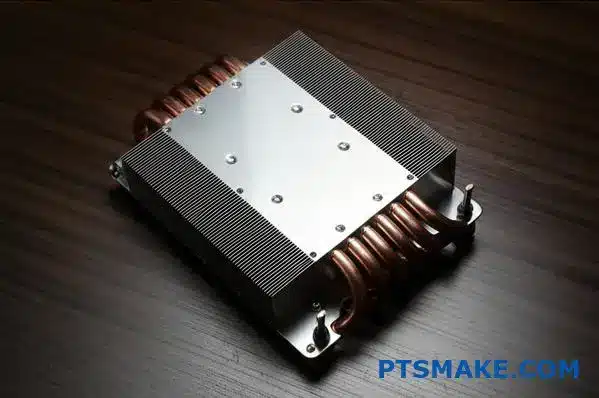
Diving Deeper: The Vapor Chamber Advantage
So, how does it work? A vapor chamber is a sealed, flat container. It has a wick structure and a small amount of fluid inside. When it gets hot, the fluid turns to vapor.
This vapor quickly fills the entire chamber. It carries heat with it. When the vapor touches a cooler surface, it condenses back into a liquid. This process releases the latent heat of vaporization14.
The wick structure then pulls the liquid back to the heat source. This continuous cycle transfers heat incredibly efficiently. It’s much faster than simple conduction through solid metal.
This process creates an almost perfectly even surface temperature. We call this isothermalization. In past projects at PTSMAKE, this has been critical for high-performance computing and compact LED lighting systems.
Performance at a Glance
| Metric | Solid Copper | Vapor Chamber |
|---|---|---|
| Effective Thermal Conductivity | ~400 W/m·K | 1,000s to 10,000s W/m·K |
| Heat Spreading | Directional, can create gradients | Two-dimensional, highly uniform |
| Weight | Heavy | Lighter |
| Complexity | Simple solid block | Engineered component |
| Ideal Application | CPU/GPU coolers, power electronics | Densely packed servers, high-power LEDs, advanced gaming consoles |
This makes vapor chambers ideal for applications with very high power density. They solve problems that even a thick copper block cannot handle effectively.
For extreme thermal challenges, solid copper reaches its limit. Vapor chambers offer a superior solution by using phase-change physics. This ensures rapid and uniform heat spreading, protecting sensitive electronics from intense, localized heat.
How does liquid cooling change the material selection debate?
Liquid cooling introduces new factors. The classic aluminum vs copper heat sink debate doesn’t disappear. It just gets a new context.
The material of the water block is important. It needs to pull heat away quickly. But it’s only the first step in the cooling process.
Shifting the Performance Bottleneck
The real work is done by the fluid and the radiator. They carry the heat away and release it into the air. A high-performance block is great, but the system is only as strong as its weakest link.
Material Choice in Context
Here’s how materials fit into the bigger picture.
| Component | Primary Material Concern | Impact on System |
|---|---|---|
| Water Block | Thermal Conductivity | High (Local Heat Transfer) |
| Radiator | Surface Area, Fin Density | High (Overall Heat Dissipation) |
| Tubing | Permeability, Flexibility | Low (Fluid Transport) |
| Coolant | Specific Heat Capacity | High (Heat Absorption) |
Ultimately, system design matters most.
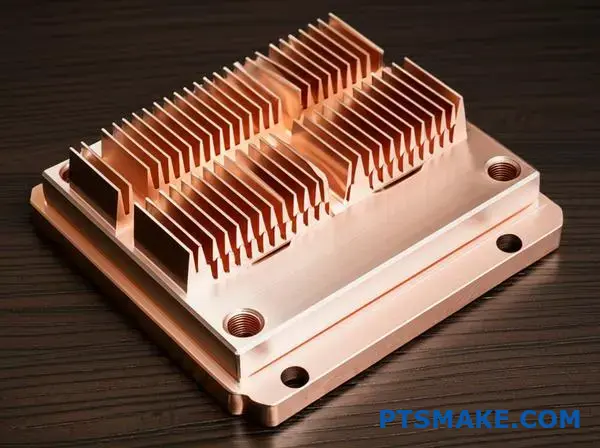
When we move to liquid cooling, we’re not just choosing a material. We are designing a complete thermal management system. The debate expands beyond just aluminum versus copper.
The Role of the Water Block
The water block’s job is to transfer heat from the chip to the liquid coolant efficiently. Copper’s superior conductivity makes it a top choice for this specific task. Aluminum is a cost-effective alternative that still performs well.
At PTSMAKE, we machine water blocks from both materials. Our experience shows that the material choice is just the beginning. The internal fin design and surface area are equally critical for performance.
System-Level Performance Factors
However, the block’s efficiency can be overshadowed by other components. The rate of Thermal Conductance15 from the block to the fluid is crucial, but it’s part of a larger chain.
| System Element | Key Performance Driver | Why It Dominates |
|---|---|---|
| Radiator | Surface Area & Airflow | The ultimate point of heat dissipation. A small radiator limits the whole system. |
| Coolant | Flow Rate & Heat Capacity | Determines how quickly heat is moved away from the block and to the radiator. |
| Pump | Pumping Power | Ensures adequate coolant flow rate, especially in complex loops. |
A system with a copper block but a small radiator will underperform. It will be beaten by a system with an aluminum block and a large, efficient radiator. We advise clients to balance their budget across the entire system, not just the block.
In liquid cooling, the focus shifts from a single component’s material to the entire system’s balance. The block material is a vital piece, but system performance is ultimately defined by the radiator and fluid dynamics.
Propose a future hybrid material for next-gen electronics cooling.
The debate of aluminum vs copper heat sink has its limits. We need to think bigger for future electronics. The next leap in cooling technology will come from hybrid materials.
Imagine a material combining the best of both worlds. I believe a Copper-Graphene Matrix (CGM) holds this potential. This composite could revolutionize thermal management. It offers performance far beyond what current single materials can achieve.
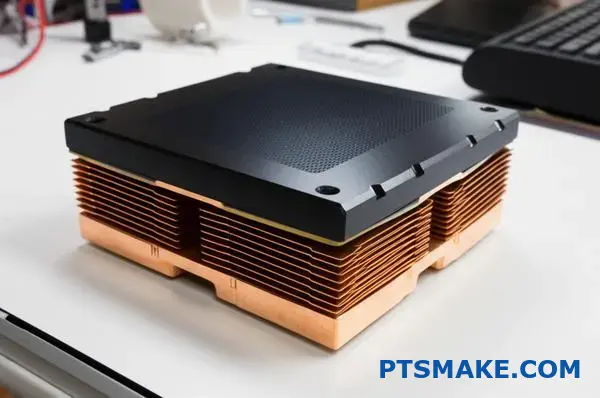
The Vision: Copper-Graphene Matrix (CGM)
For years, we’ve optimized designs using aluminum and copper. But we are reaching the physical limits of these metals. The future demands a fundamental material innovation.
Why a Hybrid Approach?
At PTSMAKE, we constantly explore materials for precision CNC machining. A hybrid approach allows us to engineer properties specifically for an application. We can create something stronger and more conductive than its parts.
Unpacking the Copper-Graphene Matrix
The concept is simple yet powerful. We infuse a copper base with graphene. Graphene has phenomenal thermal conductivity, far exceeding copper or diamond. Copper provides a stable, machinable structure.
The manufacturing challenge is ensuring a uniform bond. But the potential payoff is enormous. This material would have anisotropic16 properties, allowing us to direct heat in specific pathways with incredible efficiency.
Here is a simple comparison based on our research findings:
| Material | Thermal Conductivity (W/mK) | Key Advantage |
|---|---|---|
| 6061 Aluminum | ~167 | Lightweight & Low Cost |
| C110 Copper | ~385 | High Conductivity |
| CGM (Projected) | >1000 | Unmatched Thermal Performance |
This CGM composite wouldn’t just be an incremental improvement. It would enable entirely new product designs. We could see smaller, more powerful, and more reliable electronic devices.
This hybrid represents the next step. It moves the conversation beyond simply choosing aluminum vs copper heat sink. It’s about creating the perfect material for the job.
Hybrid materials like the Copper-Graphene Matrix offer a glimpse into the future of thermal management. They promise performance that standard metals cannot match, enabling more powerful and compact electronics by design.
Get Your Custom Aluminum or Copper Heat Sink Quote with PTSMAKE
Ready to optimize your product with expert aluminum or copper heat sink solutions? Contact PTSMAKE now for a fast, tailored quote and discover how our precision CNC machining and injection molding team can deliver the reliability, quality, and speed your project demands. Send your inquiry today!

See how this property affects material fit and performance in changing temperatures. ↩
Understand the refining process that gives C110 copper its superior thermal properties. ↩
Understand how temperature changes over a distance within a material and why it’s crucial for cooling. ↩
Learn how this property impacts your heat sink’s cooling efficiency and overall project cost. ↩
Learn how this fin-cutting technique can enhance thermal performance in your designs. ↩
Learn more about this key metric for evaluating materials in thermal management applications. ↩
Learn how repeated stress structurally weakens materials, leading to failure below their expected strength limits. ↩
Discover how this chemical process creates a protective, non-reactive surface layer on metals. ↩
Learn more about how material fatigue can impact your component’s lifecycle and design. ↩
Learn how this key metric dictates your heat sink’s cooling efficiency. ↩
Understand how this key property affects thermal performance in demanding applications. ↩
See why this physical property is the key factor in choosing a material for your heat sink. ↩
Understand how this property affects material selection for components that come into contact with users. ↩
Understand the science that powers this advanced cooling technology. ↩
Learn more about how efficiently heat is transferred through a material. ↩
Learn how a material’s directional properties can be leveraged for advanced thermal engineering. ↩